

Wikimedia Commons
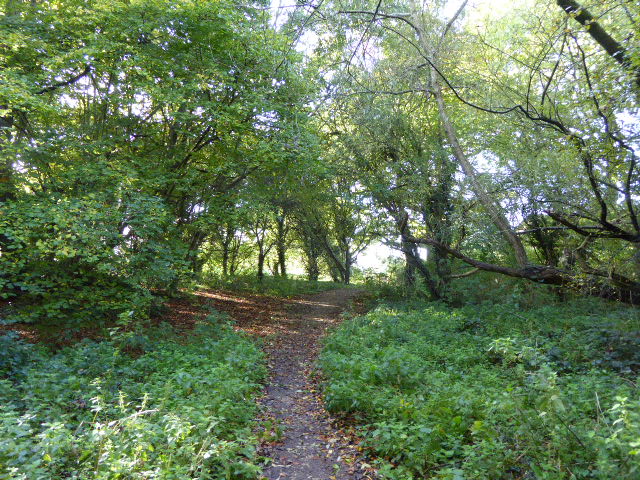
Cocksherd Wood is a 4.8-hectare (12 acres) Local Nature Reserve Statutory designation allowing principal local authorities to protect areas containing wildlife or geological features of particular local interest. in Slough, Berkshire. It is owned by Slough Borough Council and managed by Evergreen 2000. The reserve is known locally as Bluebell Wood,[1] and is an ancient woodland.[2]
The site contains a large glacial hollow, gouged out of the terrain by a glacier during the last ice age, about 15,000 years ago. It supports a wide variety of flora and fauna, notably English bluebells every April.[1][3]
History
In the Burnham Parish Title Map/Schedule 1839/42 Cocksherd Wood is marked as belonging to Lower Britwell Farm, owned by Britwell Court Estate. By 1842 Lower Britwell Farm was in the possession of Lord Godolphin, the ninth Duke of Leeds, who in 1895 sold the farm back to its original owners. Cocksherd Wood was sold to London County Council in 1951, as an amenity for its Britwell Housing Estate, built to accommodate the homeless from Central London.[2]
In 1963 London County Council became Greater London Council, and in 1979 the authority transferred the area of Britwell Housing Estate to Slough Borough Council. By 1965 the wood had become a dumping ground for old cars, washing machines, refrigerators, prams and other household rubbish.[2]
Efforts by local residents and others to clean up the wood eventually resulted in the formation of The Evergreen 2000 Trust in 1999.[2]
Flora and fauna
Flora
Hazel coppice dominates much of the wood, with ash and oak standards. Along the edges of the meadow areas there are signs of the regeneration of elm, and willows in the low-lying wet areas.[2]
Fauna
The nationally important animal species found in the wood include the Stag beetle (Lucanus cervus), the Green Woodpecker (Picis viridus) and the Bullfinch (Pyrrhula pyrrhula). In addition, the glades in the wood suport butterflies such as the Small skipper (Thymelicus sylvestris), the Small tortoiseshell (Aglais urticae), the Large white (Pieris brassicae), the Meadow brown (Maniola jurtina) and the Ringlet (Aphantopus hyperantus).[2]
