

Wikimedia Commons
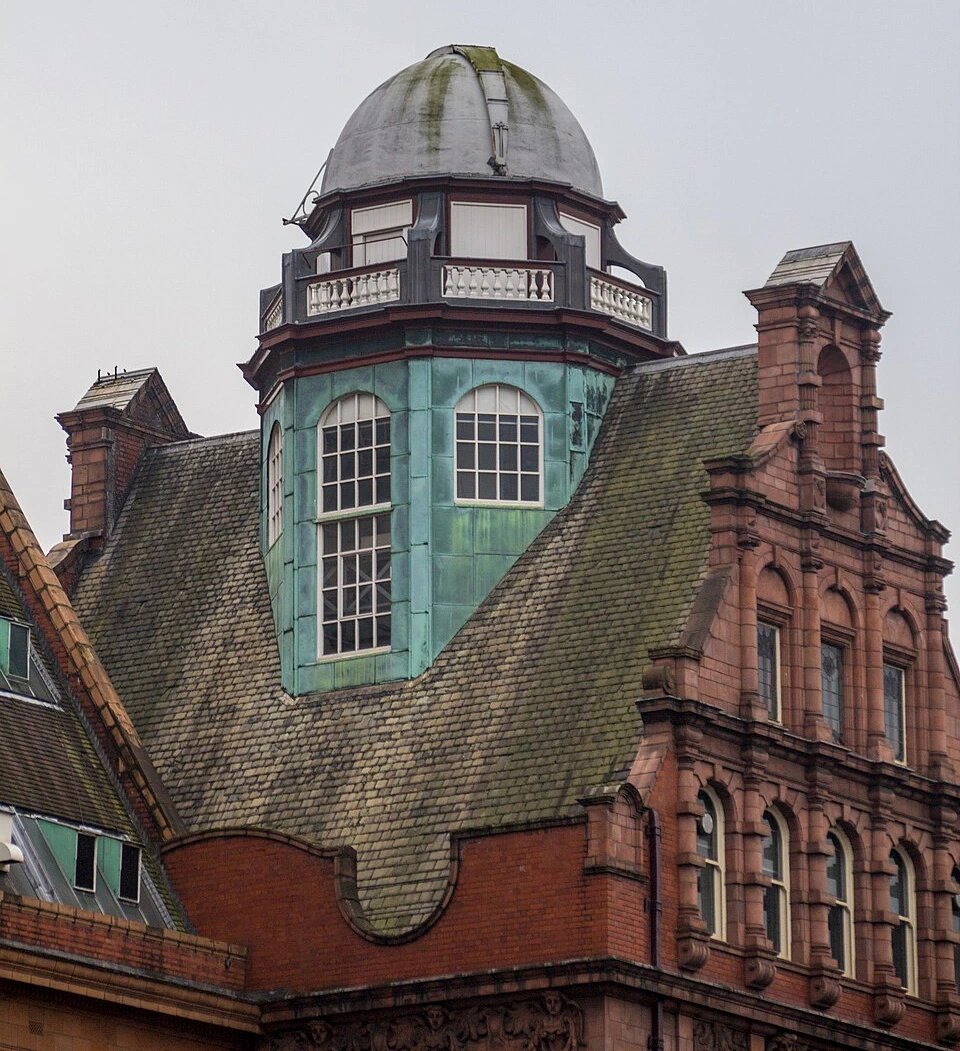
Godlee Observatory is a wooden structure built on top of the University of Manchester’s Sackville Street Building, named after the cotton magnate and philanthropist Francis Godlee, who presented it to the City of Manchester in 1903.[1][2] The Manchester Astronomical Society was granted unrestricted access to the observatory in 1946.[3]
The observatory consists of the Octagon Room, the Library and the Dome,[1] reached by a wrought-iron staircase and a trap door.[4] The Dome is made of papier-mâché to make it light enough to be rotated manually,[1] a design similar to that at the Mills Observatory in Dundee, Scotland.[5] It houses a double telescope made by Grubb of Dublin, with an 8-inch (20 cm) refractor counter-balanced by a 12-inch (30 cm) Newtonian reflector. The refractor is mainly used to view the Moon and brighter objects including the Sun, projected as a 15-inch (38 cm) disk onto a screen fastened to the tailpiece.[2]
The location of the observatory, amid the light pollution of the city centre, means that it is unable to provide good views of deep-sky objects, if indeed it ever was.[2] Nevertheless, the observatory played a small part in the 1969 Moon landing by monitoring a crater called Aristarchus, suspected of potential volcanic activity, and warning NASA of bright spots observed in the crater.[1]
The Godlee Observatory closed indefinitely in November 2022, owing to redevelopment work taking place on the North Campus of Manchester University.[6]
