
Weird Historian
Hippolyte Baraduc (1850–1902)[1] was a French physician who became interested in what was known as fluidic photography, which had its roots in the idea of animal magnetism proposed by Franz Anton Mesmer (1734–1815), and developed by the chemist and natural philosopher Carl von Reichenbach (1788–1869). The essential idea was that living organisms produce a radiation invisible to the human eye, but able to be captured in a photograph.[2]
Baraduc developed a reputation for healing his patients by the use of animal magnetism, and succeeded in producing fluidic photographs himself. But he went further, and claimed to be able to capture images displaying mental states such as the grief of a boy over the death of his pet. In his 1896 book L’Âme humaine (The Human Soul), Baraduc presented more than seventy such photographs, which he called psychicones, images of the soul created by something he called a “psycho-odic-fluidic-current”, to which the chemical mixture on the photographic plates was sensitive.[2]
Baraduc began to wonder if it might be possible to capture an image of the soul leaving the body of a recently deceased individual. His opportunity came when his son André died of consumption in 1907. Just a few hours after his son’s death, Baraduc took a picture of the corpse in its coffin. The resulting photograph showed a “formless, misty, wave-like mass, radiating in all directions with considerable force”. Although he was sceptical about the claims made for contemporary spirit photography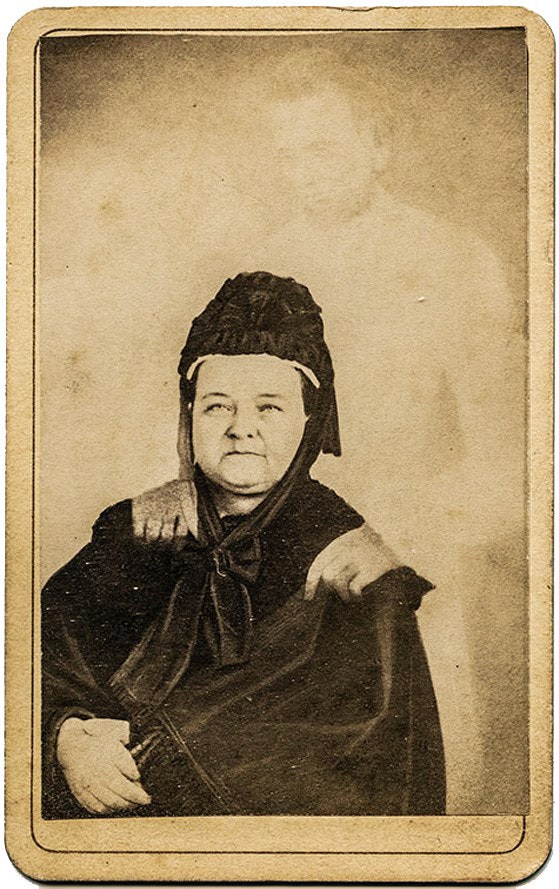 Technique popular in the 19th century to capture the invisible spirits of the deceased., believing that the sitters themselves produced the ghostly images using their psychic powers, Baraduc did not consider the possibility that he might similarly have created the image of the mist surrounding his son’s coffin.[3]
Baraduc had a second opportunity to test his hypothesis at the death bed of his wife Nadine, six months later. A photograph he took as she was very close to death showed three white globes floating above her. In another, taken fifteen minutes later, the three globes had coalesced into one.[4]
Although Baraduc was convinced that he had photographed the souls of his son and wife, it seems more likely that the images were the result of pinholes in the bellows behind the lens of his camera.[4][5]
See also
- Kirlian photography
 Process developed in the early 1940s to record corona discharges from living matter, believed by some to be evidence of an "aura" or "biofield".
 - Odic ForceFundamental force in nature claimed to have been discovered by Carl von Reichenbach in the mid-19th century, but now widely recognised as pseudoscience.

