


Wikimedia Commons
St Laurence is an active Anglican church in the village Small rural collection of buildings with a church. of Wormley, Hertfordshire. It is in the Archdeaconry of Hertford, the Deanery of Cheshunt, the Diocese of St Albans, and is a member of the BeneficeOriginally used in feudal societies to describe a grant of land as a reward for services rendered. In modern usage it refers to a collection of parishes working together under a single incumbent. of Broxbourne with Wormley.[1]
It is very likely that a church existed on the site in Saxon times, probably made of wood. During the first half of the 12th century that was replaced with a more solid construction, part of which, the nave Central part of a church, used by the laiety., is incorporated into the present structure.[1] St Laurence was designated a Grade II* listed building
 Structure of particular architectural and/or historic interest deserving of special protection. in 1961.[2]
Architecture

St Laurence consists of a nave and small chance Part of a church containing the altar, used by the officiating clergy.l. It is built with roughcast stone dressings, with flint and stone dressings on the south, and has a machine tile roof. The chancel was restored in 1843–1844; the south aisle
 Part of a church on either side of the nave or choir, separated from them by arcades, colonnades or piers. More generally, a passageway between seats in an auditorium, shelves in a supermarket and so on. and porch
 Vestibule before the main entrance to a Christian church, less sacred than the church proper. were added in 1862 by J. Clarke. The 12th-century nave has a Norman door; the windows date from the 15th century. There is a modern weatherboarded bell-cote
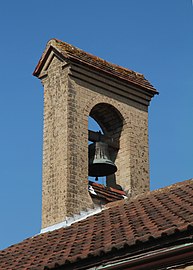 Shelter containing one or more bells. on the west end.[2]
The interior has a Saxon or early Norman circular font, and a Jacobean hexagonal oak pulpit. On the south side of the choir is an alabaster wall monument to William Purvey, joint lord of the manor, and his wife Dorothy, dated 1617.[2][3] A painting of the Last Supper over the communion table is attributed to the Italian artist Jacopo Palma, and was presented to the church in 1797 by the prominent art collector Sir Abraham Hume. There are also several 15th‑century monumental brasses, including one of John Cok, yeoman, with his wife and nine sons.[3]
