
Wikimedia Commons
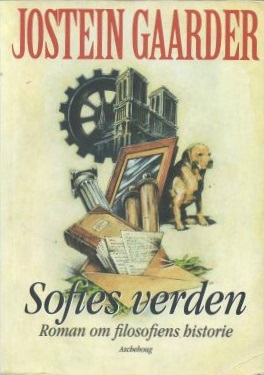
Sophie’s World is a book written by the Norwegian author Jostein Gaarder, first published in Norwegian in 1991 then in English in 1995.[1] It follows events in the life of Sophie Amundsen, a teenage girl living in Lillesand, Norway, and Alberto Knox, a middle-aged philosopher who introduces her to philosophical thinking and the history of philosophy.
The last philosophical school dealt with in the book is existentialism, a philosophy of choices defining reality, which is ultimately revealed to be the major theme of the novel; Sophie’s attempt to free herself from her creator, with the encouragement and help of Alberto Knox.
Synopsis
Sophie Amundsen arrives home from school one day, and in the mailbox she finds a letter addressed to her. Inside is a slip of paper on which is written “Who are you?” As she stands with the letter in her hand, she suddenly feels like a doll “that had been brought to life by the wave of a magic wand”.[2] Shortly afterwards Sophie finds a second letter in the mailbox, just like the first, containing a slip of paper, posing the question “Where does the world come from?” Sophie ponders the idea that at some point something must have come from nothing:
Sophie goes back to the mailbox for a third time, and finds a postcard addressed to Hilde Møller Knag, c/o Sophie Amundsen, wishing Hilde a happy 15th birthday. The card is from Hilde’s father, and says that he is sending her a present that will help her to grow, but Sophie has no idea who Hilde Møller Knag is.
The following day Sophie once again checks the mailbox, and finds a large brown envelope addressed to her, on the back of which is written “Course in Philosophy. Handle with care.”[4] She begins to receive regular packages of philosophy lessons in her mailbox from a philosopher she comes to know as Alberto Knox.
Alberto’s final lessons, which he delivers to Sophie in person, concern the British empiricist philosophers, and in particular Bishop Berkeley, who suggested that our lives may exist only in the mind of God. Alberto then reveals to Sophie that they both exist only in the mind of Albert Knag, Hilde’s father, at which point the narrative switches to Hilde’s point of view.
On the day she turns 15, Hilde receives a present from her father, who is serving with UN forces in Lebanon. It is a large ring binder containing pages written by him, titled Sophie’s World. Hilde is enthralled by the story, and comes to think of Sophie as a real person. She reads that Alberto has a plan to escape from Hilde’s father’s mind, but to do so he and Sophie must complete the philosophy course, before Hilde’s father returns home. The idea begins to dawn on Sophie that just as she and Alberto Knox exist only in the mind of Albert Knag, then perhaps he and Hilde exist only in the mind of a higher author who is writing about them.
At the end of the final chapter of the story written by Hilde’s father, Sophie and Alberto disappear. They have escaped from Albert Knag’s mind and have a new spiritual existence, invisible to other people. Sophie becomes determined to interfere in the world of Hilde and her father, and as the book ends she is learning how to do so.
