
Historic England
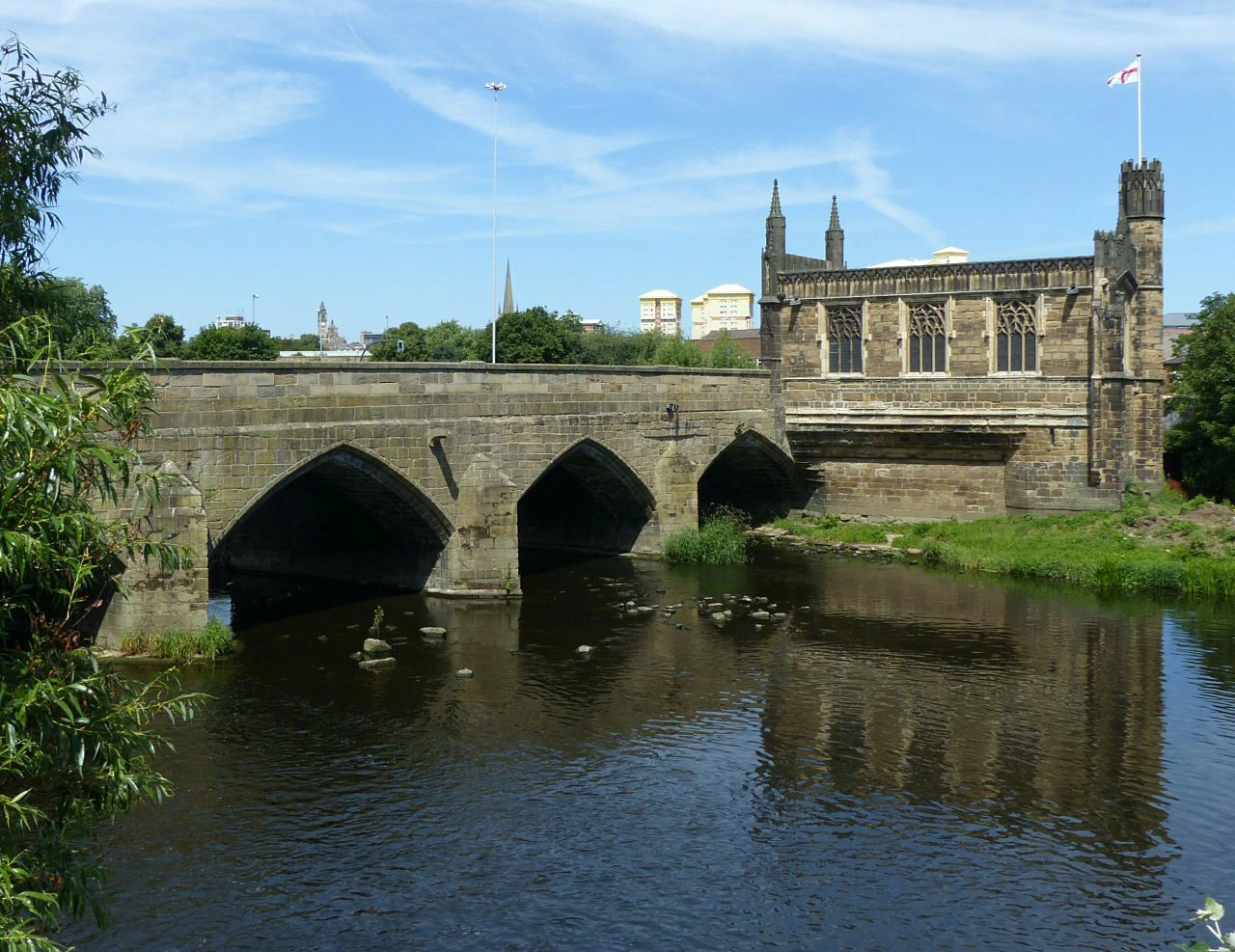
Wakefield Bridge, also known as Chantry Bridge, is a road bridge spanning the River Calder in Wakefield, West Yorkshire. It dates from the early mid-14th century, and has been widened twice, in 1758 and 1797. It replaced an earlier wooden structure on the site of an ancient ford, and was designated a Grade I listed building Structure of particular architectural and/or historic interest deserving of special protection. in 1953.[1][2]
At 320 feet (98 m) long, the nine-arched bridge is the longest surviving medieval bridge in England. It was built in two phases, the first of which began in 1342, from the north bank to a small island in the middle of the river, where a chapel Usually known as Wakefield Chantry Chapel, part of the medieval bridge over the River Calder in Wakefield, West Yorkshire, England. was built; the second phase completed the bridge from the south bank.[3]
The chapel on the bridge, an integral part of the structure, was licensed in 1356,[4] which is sometimes assumed to be the bridge’s completion date.[1] The chapel was built in part as a shrine, but also as a means of collecting money for the upkeep of the bridge.[3] The original pointed arches are visible on the downstream side, while the widened section on the upstream side has round arches. Each arch is supported by a platform with a cutwater, with a plain parapet above.[1]
