
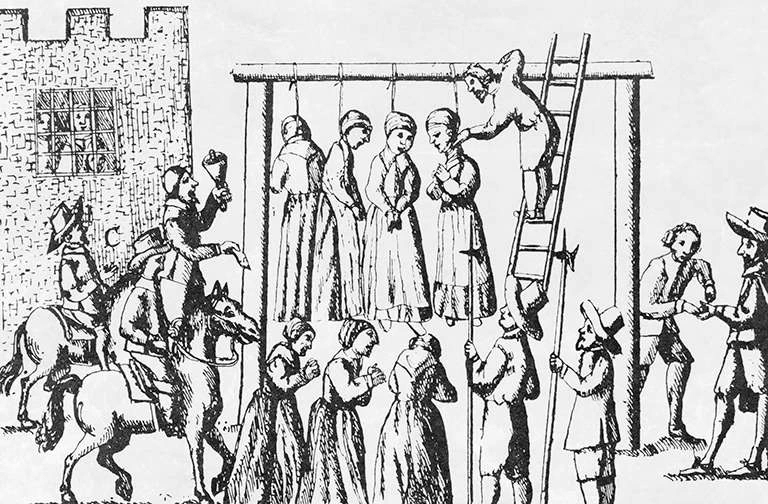
Wikimedia Commons
The English county of Cheshire did not experience the large‑scale witchcraft panics seen in neighbouring Lancashire, but there was a peak in prosecutions for witchcraft in the 1650s and 1660s, most of them presided over by the Chief Justice John Bradshaw (1602–1659).[1][a]John Bradshaw has the distinction of presiding over the court that tried King Charles I, and ordered his execution.[2] Between 1589 and 1675 there were thirty-four people prosecuted for witchcraft in Cheshire, thirty-two of them women. Thirty-one of the thirty-four were charged under the Witchcraft Act of 1604 Series of Acts passed by the Parliaments of England and Scotland making witchcraft a secular offence punishable by death., of whom eight were found guilty and executed, all of them women.[3][4]
Legal process
The legal process in Cheshire mirrored the practice of the contemporary English criminal justice system, but with some variation owing to the county’s Palatine jurisdiction.[5]
The first phase of investigation was the examination of the accused by magistrates or senior church officials, which in Cheshire took place at the Common Hall of Pleas in Chester.[3] Unlike the rest of England, which since the 12th century had been divided into six judicial circuits, with Justices visiting twice a year to preside over assize courts, as a county Palatine, Wales and Chester had four circuits of Courts of Great Sessions.[5]
If it was considered as a result of the initial hearing that there was a prima facie case to answer, the indictments gathered at the preliminary hearing were presented before judges at the Court of Great Sessions, which usually met in the Common Hall of Pleas. A jury then decided on the guilt or innocence of the accused.[3]
Executions
The 1604 Witchcraft Act had made causing harm by witchcraft a felony punishable by death. Those convicted of capital offences in Cheshire were hanged at the appropriately named Gallows Hill in Boughton, now known as Barrel Well Hill,[6] and then buried in unmarked graves in a nearby ditch, close to Chester Castle.[1]
Mary BaguleyWoman found guilty of causing the death of the schoolteacher Robert Hall by the use of magic, executed in 1675. was the last person to be executed for witchcraft in Cheshire; the last person to have been executed for witchcraft in England is generally considered to be Alice Molland Perhaps the last person to be executed for witchcraft in England, in 1685., in Exeter ten years later.[7]
| Name and date of execution[3][4] | |
| Sibil Marcer | 1631 |
| Ellen Stubbs | 1653 |
| Elizabeth Stubbs | 1653 |
| Anne Stanley | 1653 |
| Anne OsbostonEllen Beech, Anne Osboston and Anne Thornton were three women convicted in separate trials at the Court of Sessions in Chester in 1656, executed together at Gallows Hill on 8 October 1656. | 1656 |
| Anne ThorntonEllen Beech, Anne Osboston and Anne Thornton were three women convicted in separate trials at the Court of Sessions in Chester in 1656, executed together at Gallows Hill on 8 October 1656. | 1656 |
| Ellen BeechEllen Beech, Anne Osboston and Anne Thornton were three women convicted in separate trials at the Court of Sessions in Chester in 1656, executed together at Gallows Hill on 8 October 1656. | 1656 |
| Mary BaguleyWoman found guilty of causing the death of the schoolteacher Robert Hall by the use of magic, executed in 1675. | 1675 |
See also
- Witch trials in Early Modern EnglandHistory of witch trials in England from the 15th to the 18th century.
Notes
| a | John Bradshaw has the distinction of presiding over the court that tried King Charles I, and ordered his execution.[2] |
|---|
