


Wikimedia Commons
St Mary’s is an active Anglican church in Whitkirk, a suburb of Leeds, in West Yorkshire. It is in the Archdeaconry of Leeds, the Deanery of East Leeds, and the Diocese of Leeds.[1] There has probably been a church on the site since at least 1185, but the present building dates mainly from the 14th and 15th centuries, with later additions.[2]
The chancel Part of a church containing the altar, used by the officiating clergy. was rebuilt in 1901 by G. F. Bodley, and was re-ordered in about 1990.[3]
St Mary’s was designated a Grade I listed building in 1963.[3] The lych gate Roofed-over gateway into a churchyard. and churchyard wall to the north and east of the church are separately designated as Grade II structures.[4]
Architecture
Exterior
Built in the Perpendicular style, St Mary’s has a west tower with diagonal buttresses and carved obelisk pinnacles, a two-light belfry Structure in which bells are hung. and a lead-clad spire. Heavy nave
 Central part of a church, used by the laiety. and aisle
 Part of a church on either side of the nave or choir, separated from them by arcades, colonnades or piers. More generally, a passageway between seats in an auditorium, shelves in a supermarket and so on. parapets project on large corbels
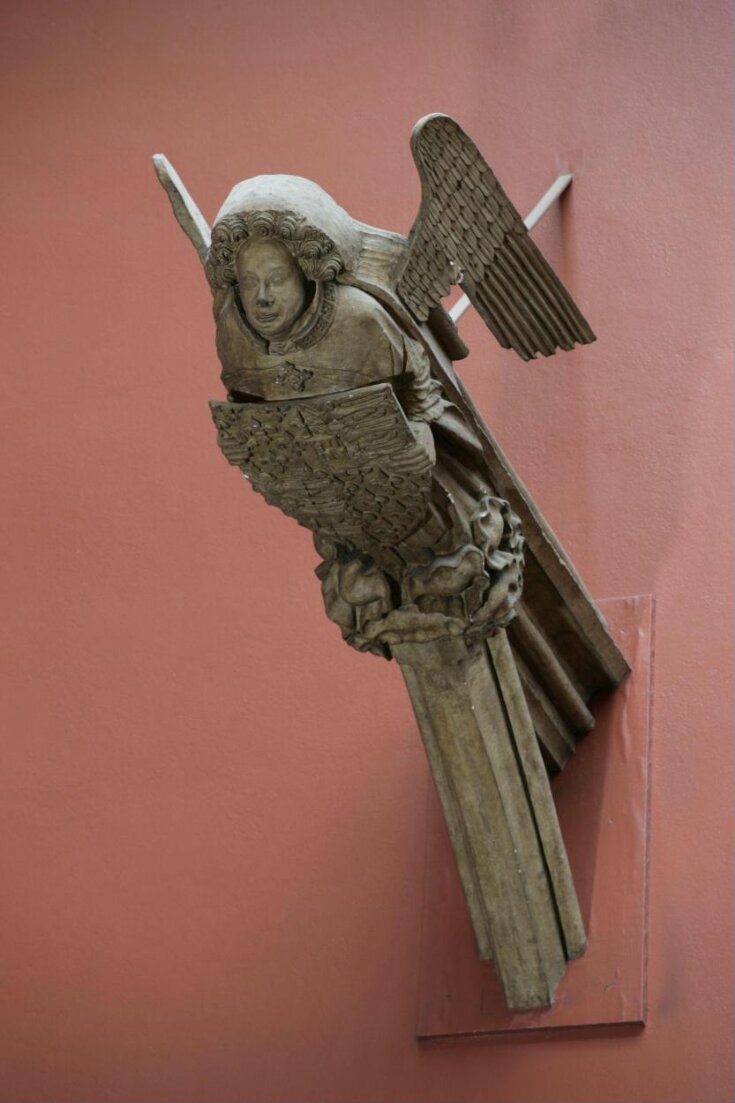 Structural piece of stone, wood or metal jutting from a wall to carry a superincumbent load., and there is a gabled south porch
 Vestibule before the main entrance to a Christian church, less sacred than the church proper.. There are small arched clerestoryUppermost range of windows in the wall of a church, or a row of windows above eye-level. windows, and large three-light pointed north and south aisle windows.[3]
Interior

Wikimedia Commons
St Mary’s has a short nave with arcades Series of arches carried on piers, columns or pilasters. Also used to denote a covered avenue with shops on one or both sides. of short octagonal piers with double-chamfered arches. The south chapel in the chancel was founded as a chantry
 Private chapel with an altar for the celebration of Mass for the souls of the founder and his or her nominees. in 1448–1449.[3] The piscina
 Small basin in a Christian church used to clean the priest's hands and the sacred vessels used at Mass. and the font, made from a single block of magnesium limestone, date from the 12th century.[2] There is a tomb chest to Sir Robert Scargill, d. 1531–2 and his wife, d. 1546–7, complete with mourners and recumbent alabaster effigies above. John Smeaton, often regarded as “the father of civil engineering”, is buried under the chancel.[3][5]
Organ
The organ, built by Abbott & Smith of Leeds, was installed in 1931, and has since been twice rebuilt: in 1982 and most recently in 2010, by J. M. Spink of Leeds.[6]
