


Wikimedia Commons
St Wilfrid’s is an active Anglican Church in the former pit-village of Standish, Greater Manchester. It is in the Archdeaconry of Blackburn, the Deanery of Chorley and the Diocese of Blackburn, and is a member of the BeneficeOriginally used in feudal societies to describe a grant of land as a reward for services rendered. In modern usage it refers to a collection of parishes working together under a single incumbent. of Standish.[1]
The church is believed to have been built between 1582 and 1584, and was probably designed by Laurence Shipway. It has been described as “one of the most interesting churches in Lancashire”,[2][a]Until 1974, and the implementation of the Local Government Act 1972, Standish was in the county of Lancashire. and a “rare example” of a 16th-century church. St Wilfrid’s was designated a Grade I listed building in 1966.[3] The gatehouse to the church is separately listed as a Grade II structure.[4]
Architecture
Exterior
St Wilfrid’s is built largely of yellow-black gritstone, except for the grey-black ashlar Masonry of squared and finely cut or worked stone, commonly used for the facing of a building. tower.[5] It consists of a five-bay nave
 Central part of a church, used by the laiety., chancel
 Part of a church containing the altar, used by the officiating clergy., aisles
 Part of a church on either side of the nave or choir, separated from them by arcades, colonnades or piers. More generally, a passageway between seats in an auditorium, shelves in a supermarket and so on., north and south chapels
 Christian place of prayer and worship, smaller than a church., west tower and east vestry
 Room in Christian churches for the storage of liturgical vestments, sacred vessels and parish records.. The west tower was added in 1867, and the east vestry in 1913–1914 by Austin and Paley.[3]
Interior
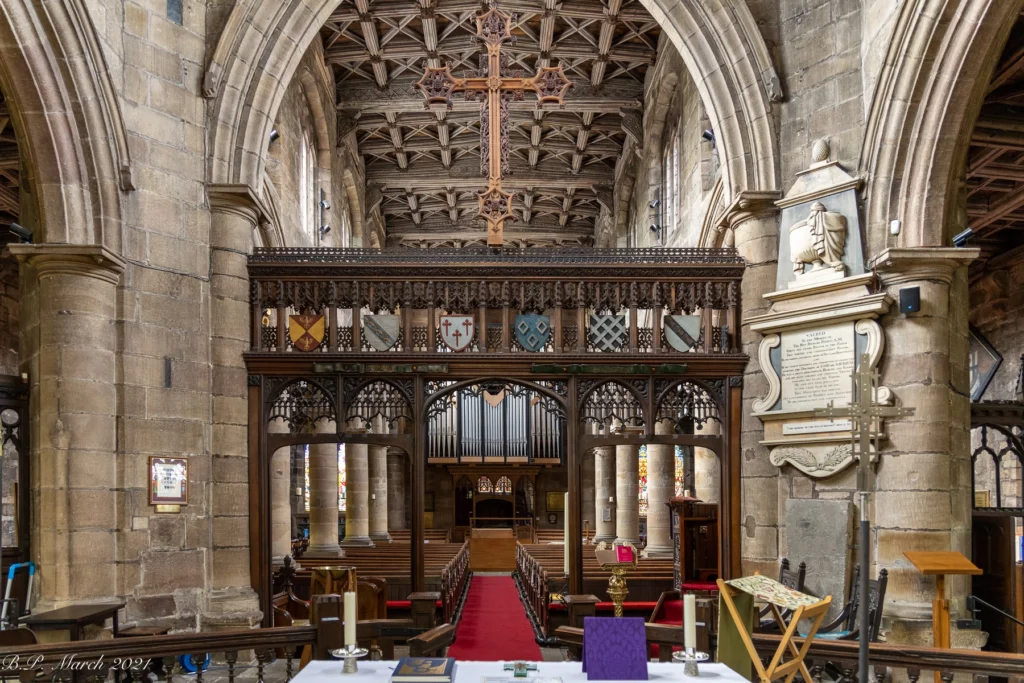
The nave and chancel arcades Series of arches carried on piers, columns or pilasters. Also used to denote a covered avenue with shops on one or both sides. have pointed arches on Tuscan columns with plinths, believed to be the earliest use of the order in England.[3] The architectural historian Simon Jenkins has described St Wilfrid’s as having “the finest roof in Lancashire”.[5]
St Wilfrid’s was placed on the Heritage at Risk Register by Historic England in 2025, following the discovery of an infestation of deathwatch beetles in the timber roof.[6]
Notes
| a | Until 1974, and the implementation of the Local Government Act 1972, Standish was in the county of Lancashire. |
|---|
