
Paula Ebner
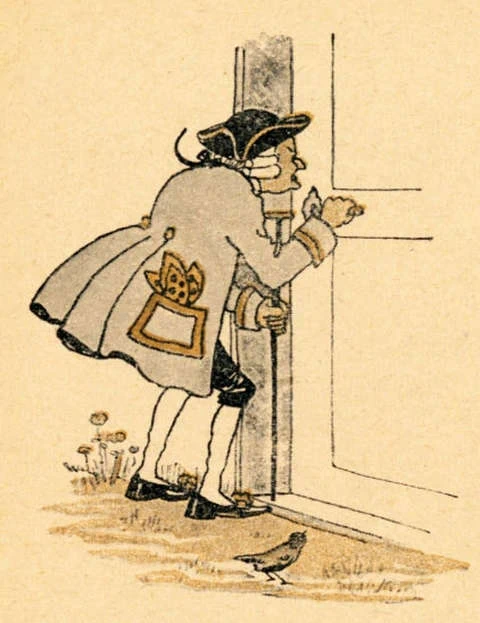
“Herr Korbes”, known in English as “Mr. Korbes” or “Squire Korbes”, is a German fairy tale collected by the Brothers Grimm.[a]Korbes is the German word for “basket”. It was first published in their 1812 Kinder und Hausmärchen (Children’s and Household Tales), as tale number 41. This kind of folk-tale has an Aarne–Thompson–Uther (ATU) type of 210: The Traveling Animals and the Wicked Man.[1]
The story concerns a group of animals and inanimate objects that, for reasons unspecified, inflict pain and suffering on the title character, eventually resulting in his death. The final sentence – “Herr Korbes must have been a very wicked man” – was added in the third edition, published in 1837.[1]
Synopsis
A rooster and a hen decide they want to take a journey together, so the rooster builds a handsome carriage with four red wheels, to which he hitches four mice, and off they set. Along the way they meet a cat, who asks where they are going, to which they reply “Herr Korbes’s house”; the cat asks to join them.
In similar fashion they collect a millstone, an egg, a duck, a pin, and finally a needle. When they reach Herr Korbes’s house he is not at home. The mice pull the carriage into the barn, and the hen and the rooster fly onto a pole, while the other visitors deploy themselves around the house. The cat settles down in the fireplace and the duck in the water bucket; the egg rolls itself up in a towel, the pin sticks itself into a chair cushion, the needle jumps onto the bed in the middle of the pillow, and the millstone lies down above the door.
On returning home, Herr Korbes tries to light a fire, but the cat throws ashes in his face. While washing himself in the kitchen, the duck splashes him with water, and when he tries to dry himself with the towel the egg breaks, gluing his eyes shut. Sitting down in the chair he is pricked by the pin, and enraged, he throws himself onto the bed, where he is pricked by the needle in the pillow. He screams and tries to run out of the house, but as he passes through the front door the millstone jumps down and strikes him dead.
Commentary
The American folklorist Maria Tatar has described Herr Korbes as “one of the most mystifying figures of folklore”. The first English translator, Edgar Taylor, was so baffled by it that he wrote to the Grimms asking who this Herr Korbes was. The reply he received was that Herr Korbes was another name for the Butzemann (bogeyman), or Knech Ruprecht, the sinister figure accompanying St Nicholas from house to house looking for naughty children.[2]
Notes
| a | Korbes is the German word for “basket”. |
|---|
