
Spooky Isles
Early one Sunday morning in July 1971, three workmen were making their way along a deserted street in the Wapping district of East London, near the River Thames, when they encountered someone dressed as an 18th-century clergyman. The men passed the clergyman, but when they turned round to look back he was nowhere to be seen, the street was deserted. They were convinced they had witnessed the phantom of the evil Vicar of Ratcliffe Wharf, who was said to haunt the area.[1] Other witnesses included a local woman who described the figure as having flowing grey hair, dressed in a white shirt with a cloak; the landlord of a local public house who claimed that his daughter and her child had seen the spectre; and two policemen.[2]
But they were all victims of a hoax perpetrated in 1970 by Frank Smyth, an associate editor of Man, Myth and Magic, a magazine dealing with paranormal phenomena. During a liquid lunch with his friend John Philby, who was renovating an old warehouse in the area, they decided it would be fun to create a ghost story.[2]
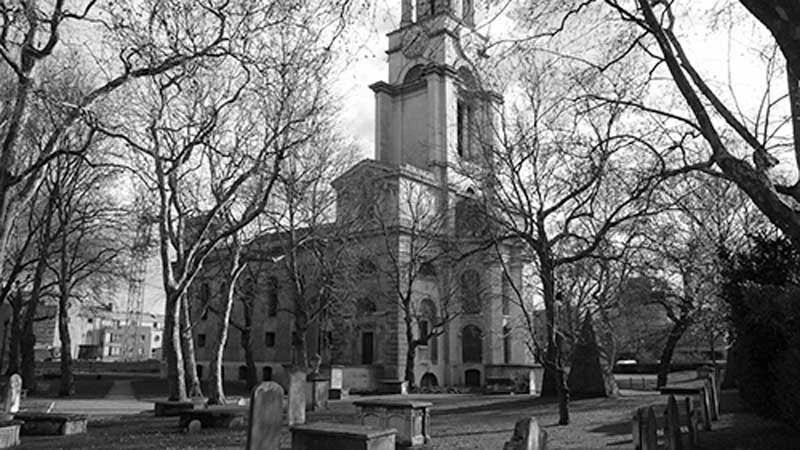
Throughout the 19th century Ratcliffe Wharf was a busy dock, and had become “a hotbed of iniquity, crammed full of gambling dens, drinking houses and brothels”. So Smyth invented the story of a former vicar of St Anne’s, the largest church in the area, who set up a guest house for sailors. The vicar was said to have paid attractive young women to lure sailors into his guest house, where he would batter them to death with his silver-topped cane, steal their money, and dump their bodies in the River Thames. Smyth published his story in the latest edition of Man, Myth and Magic, and to add a degree of apparent veracity, claimed that both he and Philby had seen the ghost.[2]
Three years after the publication of Smyth’s story, a BBC2 documentary programme, A Leap in the Dark, featured the hoax in a dramatised account of the phantom vicar of Ratcliffe Wharf.[2][3] In an interview with the Sunday Times in 1975 Smyth admitted that he had invented the story, explaining that “he was so fed up with stories about modern ghosts that he decided to invent a good old-fashioned ghost and the derelict wharves seemed a perfect location for the mythical old vicar”.[4]
The psychic investigator Richard Wiseman has suggested that what the phantom vicar hoax demonstrates is that “hauntings do not require genuine ghosts, recording walls Idea that recurrent hauntings are produced by the replaying of recordings stored in the physical environment, analogously to tape recordings., underground streams, low frequency sound waves or weak magnetic fields. Instead, all it takes is the power of suggestion”.[2]
