
Wikimedia Commons
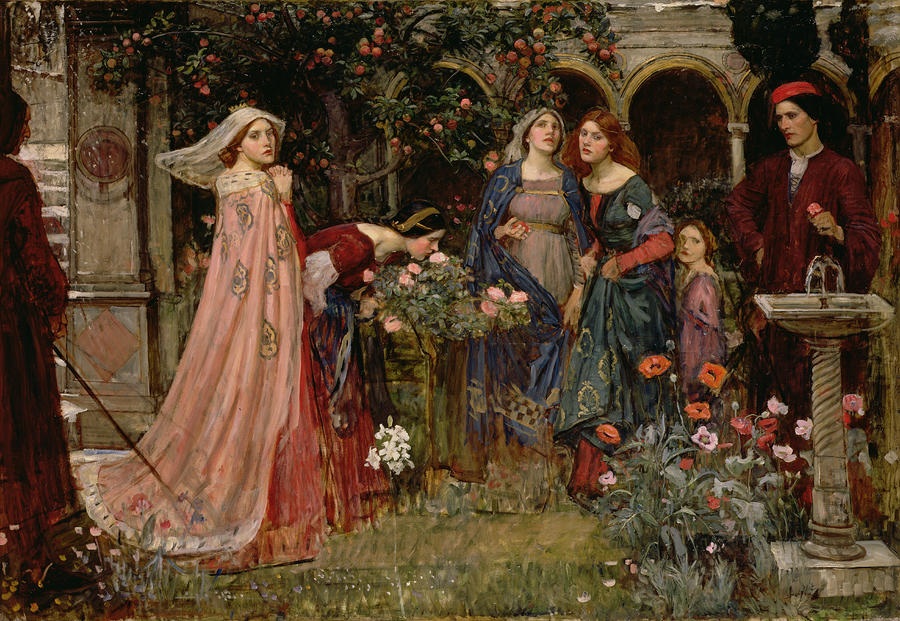
The Enchanted Garden is an oil painting in the Pre-Raphaelite Group of English artists formed in 1848 to counter what they saw as the corrupting influence of the late-Renaissance painter Raphael. style by John William Waterhouse
 English artist known primarily for his depictions of women set in scenes from myth, legend or poetry. He is the best known of that group of artists who from the 1880s revived the literary themes favoured by the Pre-Raphaelites., unfinished at his death in 1917.[1] It was nevertheless displayed at the Royal Academy exhibition that year as a token of respect by his counterparts.[2]
The painting is an illustration of a story contained in the Decameron (c. 1350) by Giovanni Boccaccio, which concerns ten young people who escape the plague in Florence by fleeing to the countryside. To pass the time, they entertain each other with songs and storytelling; Waterhouse’s painting is an illustration of the fifth story told on the tenth day.[3]
The story tells of a young man, Ansaldo, who falls in love with Dionara, a married woman. Despite her best efforts to rebuff him, Ansaldo persists in pursuing her. Finally she tells Ansaldo that she will only become his lover if he will perform what she considers to be an impossible task: to produce a summer garden in the middle of winter. But with the help of a magician Ansaldo succeeds in the task, and sends Dionara fruit and flowers from the garden. She arranges with her companions to go and look at the garden, which is the scene depicted in The Enchanted Garden, showing the distraught Dionara on the left-hand side of the painting.[3]
William Hesketh Lever, 1st Viscount Leverhulme, probably bought The Enchanted Garden shortly after Waterhouse’s death. On Lever’s foundation of the Lady Lever Art Gallery in Wirral, Merseyside in 1922, named in memory of his deceased wife,[a]Lady Lever died in 1913.[4] he transferred the painting to the new gallery, where it remains today.[5][6]
