
“The Malice of Inanimate Objects” is a ghost story by the English medievalist and author M. R. James (1862–1936), first published in June 1933 in the first issue of The Masquerade, an Eton College ephemeral magazine.[a]James was the provost of Eton College from 1918 to 1936.[1] The story then fell into obscurity until its rediscovery by the biographer Michael Cox, while researching for his 1983 book M. R. James: An Informal Portrait. It was subsequently reprinted in Ghosts & Scholars in 1984.[2]
The literary critic Bob Hodges has suggested that the story’s title “aptly summarizes [James’s] oeuvre”.[3]
Synopsis
The story is told as a first-person narrative, and opens with the observation that “in the lives of all of us, short or long, there have been days, dreadful days, on which we have had to acknowledge with gloomy resignation that our world has turned against us”. Retelling the tale of “Squire Korbes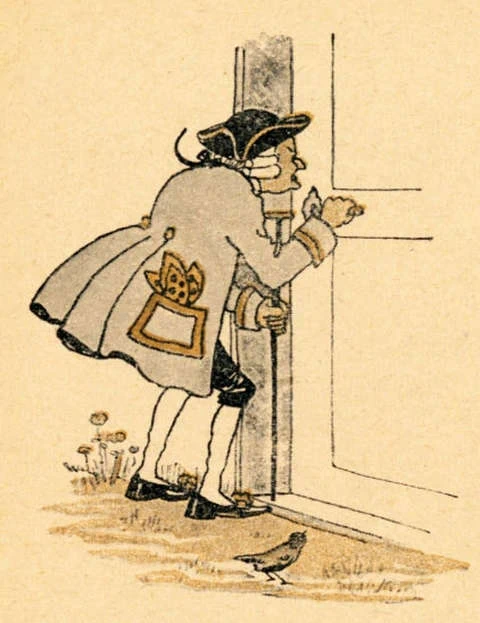 German fairy tale collected by the brothers Grimm. It concerns a group of animals and inanimate objects that inflict pain and suffering on the title character.“, the narrator remarks “I know, the fact that Squire Korbes’s visitors were not all of them, strictly speaking, inanimate. But are we sure that the perpetrators of this Malice are really inanimate either?”
Two men of “mature years”, Mr. Manners and Mr. Burton, are sitting in a garden after breakfast. Manners reads in his newspaper that George Wilkins has died by suicide; he speculates that the “row” between Wilkins and Burton may have caused it. Burton angrily responds that Wilkins “… hadn’t a leg to stand on: he couldn’t bring a scrap of evidence.” The two men take a walk, during which Burton suffers various misfortunes, including tripping over a kite string. The kite has been painted with two red eyes, and the letters “I C U” are printed in red text. As the two men turn a corner, they hear a muffled, choked voice say “Look out! I’m coming”. During the remainder of the day, Burton continues to suffer mishaps, including choking at lunch, breaking his pipe, tripping on a carpet, and dropping a book in the garden pond.
Burton is forced to cut his visit to Manners short after being summoned back to town. Before leaving the next morning, he mentions to his host that he plans to visit a doctor, as his hand is so shaky he dare not shave. Burton obtains a private compartment on the train home, but the narrator notes, “these precautions avail little against the angry dead”. Burton is found dead on the train, his throat cut, with a napkin on his chest bearing red letters reading “GEO. W. FECI”.[b]Feci is a Latin word that translates as “I did”, or “I have done”.
The narrator concludes by saying that “there is something not inanimate behind the Malice of Inanimate Objects”, that “when this malice begins to show itself we should be very particular to examine and if possible rectify any obliquities in our recent conduct”, and that “like Squire Korbes, Mr Burton must have been either a very wicked or a singularly unfortunate man”.
Commentary
The literary scholar Penny Fielding considers the “Freudian-entitled ‘The Malice of Inanimate Objects’ ” to be an example of James’s “marked disregard for any kind of conventional plotting”, particularly evident in his later stories. The supposed ghost of Geo W. Feci never materialises, and the story fails to make any connection between the apparently trivial but annoying events of Burton’s day and his death. “This uneasy relationship between objects and their ordering in the cause-and-effect narration of the ghost story” is characteristic of James’s style.[4]
