
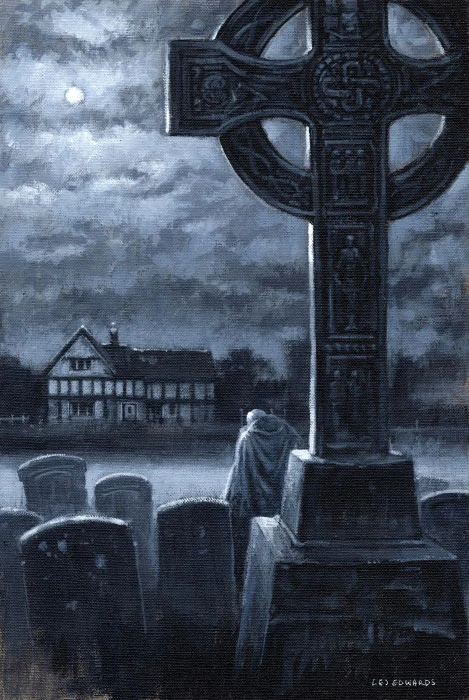
“There Was a Man Dwelt by a Churchyard” is a ghost story by the English medievalist and author M. R. James (1862–1936). It was first published in the Eton College magazine Snapdragon on 6 December 1924, and is included in The Collected Ghost Stories of M. R. James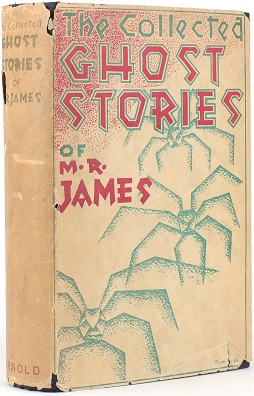 Collection of all but four of the ghost stories written by the English medievalist and author M. R. James, first published in 1931. (1931).[1] Told as a third-person narrative, the story’s framing device is “the sad tale [of] sprites and goblins” that Prince Mamilius begins to tell Queen Hermione and her court ladies in Act II, Scene 1 of William Shakespeare’s play The Winter’s Tale, cut short when the Queen is arrested by the King’s guards.
Mamilius dies shortly afterwards, without having the opportunity to finish his story, but the narrator nevertheless claims to know how it ends.
Synopsis
Set in the Elizabethan era, Mamilius’s story centres on John Poole, an elderly widower known as “something of a miser”. Poole moves into a house that overlooks his village’s churchyard, after the former resident, the parish priest, vacated the premises at his wife’s insistence; she claimed to have seen something in the churchyard at night. In those days it was common to bury people at night, by torchlight, and it was noticed that Poole was always watching from his window whenever a funeral took place.
One night a wealthy but unpopular elderly woman is buried. Although said by her neighbours to be not a Christian, and that on such nights as Midsummer Eve and All Hallows, she was not to be found in her house, she has bequeathed “a purse of money” to the church. During the funeral, the parson throws “something that clinked” into the grave and says, “Thy money perish with thee”. The following day, churchgoers rebuke the sexton for the untidy work he has made of filling in the grave; the sexton reflects that “he thought it was worse than he had left it”.
Poole’s nature subsequently changes; he becomes “half exulting [and] half nervous”, and begins visiting the village inn, where he hints at having come into money, and of planning to move to a new house. The blacksmith remarks that he would not want to live next to the churchyard for fear of “somebody climbing up to the chamber window” and asks Poole if he has ever seen lights, which he denies.
Returning home late that night, Poole cannot sleep. He takes “something that clinked” out of a cupboard and puts it in his bedgown pocket. Looking out of his window, he sees something that resembles a shrouded figure sticking out of the ground. Lying in his bed, Poole hears the casement window rattle, and a figure enters the room. He hears dry earth rattling on the floor, faltering footsteps, and a “low cracked voice” saying “Where is it?” The figure opens the cupboard but finds it empty, then moves next to the bed, raises its arms, and screams hoarsely “You’ve got it!”
In the framing device, Prince Mamilius then throws himself upon the youngest of the court ladies, causing her to scream. He is shaken and severely slapped by Queen Hermione, but is permitted to remain after the court lady forgives him.
Critical reception
The writer Richard Boerem has suggested that “There Was a Man Dwelt by a Churchyard” is an example of James being “… a writer who wishes to let the reader feel a semblance of truth in the stories without forgetting that they are stories”.[2]
The writer and critic Darrell Schweitzer, on the other hand, has described “There Was a Man Who Dwelt by a Churchyard” as an example of James’s works that are “merely elaborate methods of saying ‘Boo!’ – of making the reader or hearer jump [with] no philosophical or thematic freight”.[3] The science-fiction writer Rosemary Pardoe has written that “To call ‘There was a Man’ a story is really a misnomer, for it scarcely has a plot and is merely a small but mildly amusing joke.”[4]
References
Works cited
External links
- Full text of “There Was a Man Dwelt by A Churchyard” at Project Gutenberg
