

Wikimedia Commons
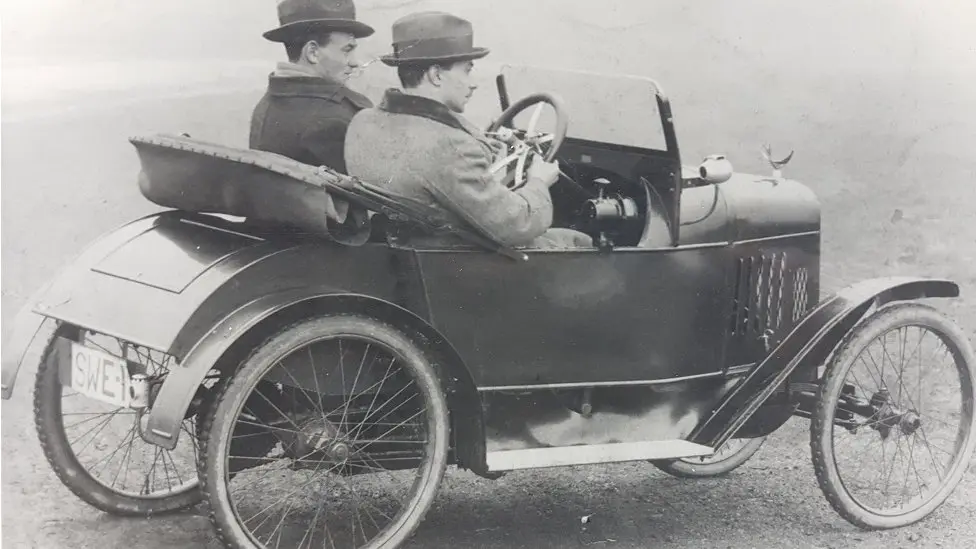
The Gnome is a cyclecar Small, inexpensive automobile that filled the gap in the market between the motorcycle and the car. built by the London manufacturer Gnome Cars from 1925 until 1926, in which year the name of the company and the car was changed to Nomad.[1]
Power was provided by a single-cylinder, air cooled, two stroke 343 cc Villiers engine mounted at the rear of the car, driving the rear wheels via friction transmission, giving four speeds in forwards and reverse.[1] The integral body and chassis were made of steel and plywood, and suspension was provided by the Dunlop balloon tyres, inflated to only 6 psi (0.41 bar). The front bonnet gave access to a luggage compartment.[2]
The car was claimed to have a top speed of 40 mph (64 km/h) and a fuel consumption of 50 mpg (18 km/l).[2] It was originally priced at £75, which increased to £100 when the branding was changed to Nomad in 1926, and an electric starter was introduced.[1] It is unknown how many vehicles were built, but it is almost certainly in the tens rather than the hundreds.[2]
 Cyclecar manufactured from 1919 until 1920.
 Three-wheeled cyclecar built between 1921 and 1922.
 Cyclecar manufactured from 1921 until 1922.
 Cyclecar produced from 1912 until 1914, distinguished by being offered with a cane basketware body.
 Four-wheeled cyclecar built by Black Prince Motors of Barnard Castle, County Durham, between 1919 and 1924.
 Cyclecar produced from 1913 to 1914.
 Three-wheeled, single-seat cyclecar made in 1920–1921 by the Central Aircraft Company of Northolt, Middlesex. It was one of the cheapest cars on the market.
 Bicycle, cyclecar and motorcycle manufacturer active from 1893 to 1926.
 Three-wheeled cyclecar produced from 1919 to 1922, the cheapest car on the British market at that time.
 Range of cyclecars produced by the Rollo Car Co. of Birmingham between 1911 and 1913.
 Cyclecar produced by the Coventry-based bicycle manufacturer Rudge-Whitworth between 1912 and 1913.
 The only cyclecar ever to have been produced commercially in Scotland.
 Four-wheeled cyclecar built from 1912 to 1915.
