
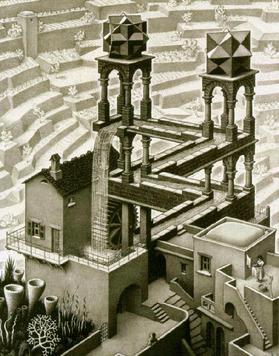
38 cm × 30 cm (15 in × 12 in)
Wikimedia Commons
Waterfall is a lithograph by the Dutch artist M. C. Escher (1898–1972), first printed in 1961.[1] It shows a perpetual motion machine, in which water from the base of a waterfall appears to run downhill along the water path before reaching the top of the waterfall. The watercourse is constructed of square beams resting upon each other at right angles. In the words of the artist,
The visual paradox is achieved by the incorporation of three Penrose triangles Visual representation of a triangular frame that could not exist in three-dimensional space. into the depiction of the corners of the watercourse, an impossible object formally described by Lionel and Roger Penrose in 1958.[2]
The two towers appear to be the same height, despite the one on the right being a storey lower than the one on the left.[1] Below the mill is a garden of bizarre, giant plants, a magnified view of a cluster of moss and lichen that Escher drew in ink as a study in 1942.[3]
Waterfall is one of the three of his works that Escher characterised as impossible buildings. The two others are Ascending and Descending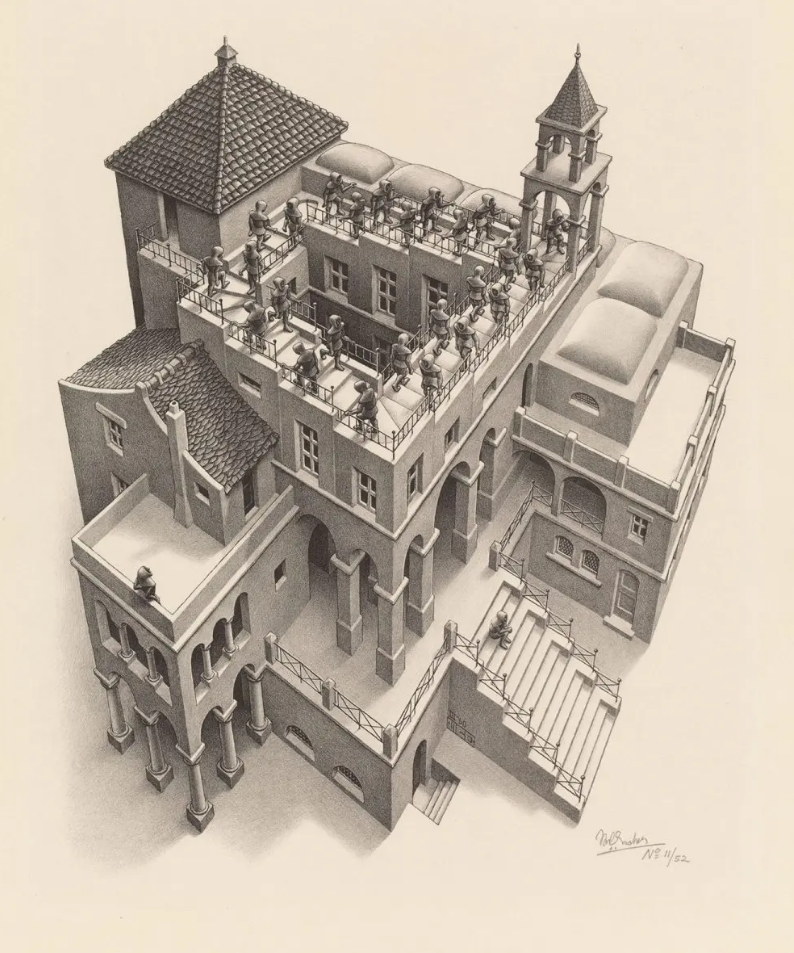 Lithograph created by the Dutch Artist M. C. Escher in 1960, one of his depictions of impossible buildings. and Beldevere
 Lithograph by the Dutch artist M. C. Escher, created in 1958..[4]
