
26 × 47 cm (10.2 × 18.5 in)
Wikimedia Commons
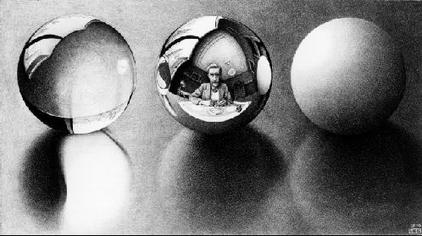
Three Spheres II is a lithograph by the Dutch artist M. C. Escher (1898–1972), first printed in 1946. It depicts three spheres of equal size placed next to each other on a shiny table. The one on the left is made of glass and is filled with water, so it is both transparent and reflecting. The right-hand sphere has a matt surface. The central sphere features a reflection of the artist in the act of drawing the picture, with the three spheres in front of him, surrounded by almost all of the area around him. The point between the artist’s eyes is at the absolute centre of the central sphere, so whichever way he turns, he remains at the centre.[1]
Escher was fascinated with the idea that a mirrored ball captures almost the full sweep of visual space in all directions, demonstrated in many of his other works such as Still Life with Reflecting Globe, Hand with Reflecting Globe Lithograph by the Dutch artist M. C. Escher, first published in 1935., and Dewdrop.[2] Three Spheres II achieves a “triple unity” in two ways: “not only does it [the central sphere] reflect its companions to left and right, but all three of them are shown in the drawing on which the artist is working.[1]
