
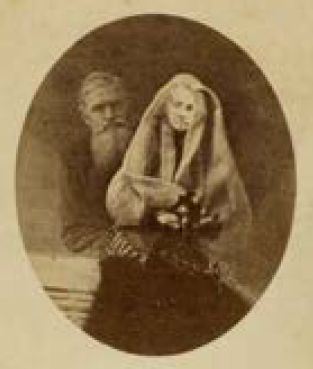
Wikimedia Commons
Frederick Hudson was a Victorian-era spirit photographer Technique popular in the 19th century to capture the invisible spirits of the deceased., active in his Kensington studio in London from 1872. He worked with the medium Georgiana Houghton,[1][2] and is credited as being the first spirit photographer in Britain.[3]
A fellow spiritualist System of beliefs and practices intended to establish communication with the spirits of the dead., William Henry Harrison, exposed Hudson’s photographs as fraudulent, as did another who demonstrated “conclusively” that Hudson’s spirits “were faked by a simple process of double exposure.”[4]
Nevertheless, in 1874 the naturalist and co-founder of the theory of evolution with Charles Darwin, Alfred Russel Wallace, visited Hudson, resulting in a photograph of him with his deceased mother. Wallace declared the photograph genuine, declaring “I see no escape from the conclusion that some spiritual being, acquainted with my mother’s various aspects during life, produced these recognisable impressions on the plate.”[5]
Hudson was known for staging his spirit photographs by dressing up as spirits or using double-exposure techniques. The psychic investigator Joe Nickell has noted that, in many instances, the sitter is positioned low in the frame to leave room for the “spirits” that Hudson had arranged to insert.[6]
The professional illusionist and psychic investigator Milbourne Christopher has written:
