
Wikimedia Commons
Faced with air raids from German Zeppelins and aircraft during the First World War, the first of them on Great Yarmouth, Sheringham and King’s Lynn in Norfolk, on 19/20 January 1915,[a]The Kaiser initially forbade attacks on London, fearing that his relatives in the British Royal family might be injured.[1][2] The first raid on the city took place on 31 May 1915.[3] the recently formed Royal Air Force began to experiment with methods of detecting approaching aircraft at distances of up to 15 miles (24 km).[1][2][4]
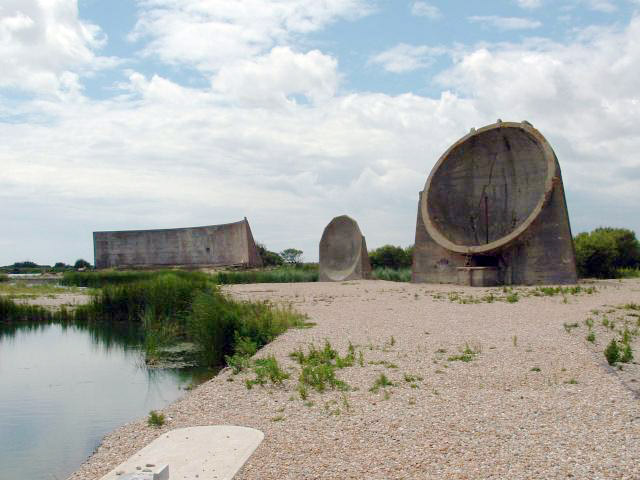
Major William Sansome Tucker proposed a network of acoustic mirrors, also known as sound mirrors, the development of which continued until the mid-1930s, when radar made them obsolete.[5] The first acoustic mirror was constructed at Dover in 1917.[4]
Acoustic mirrors were concrete bowls or lengths of concave wall. A microphone was moved about in front of the mirror while an observer listened to the sound of an approaching aircraft through headphones. The position of the microphone where the sound was loudest allowed the direction and height of the aircraft to be calculated.[4]
