
Wikimedia Commons
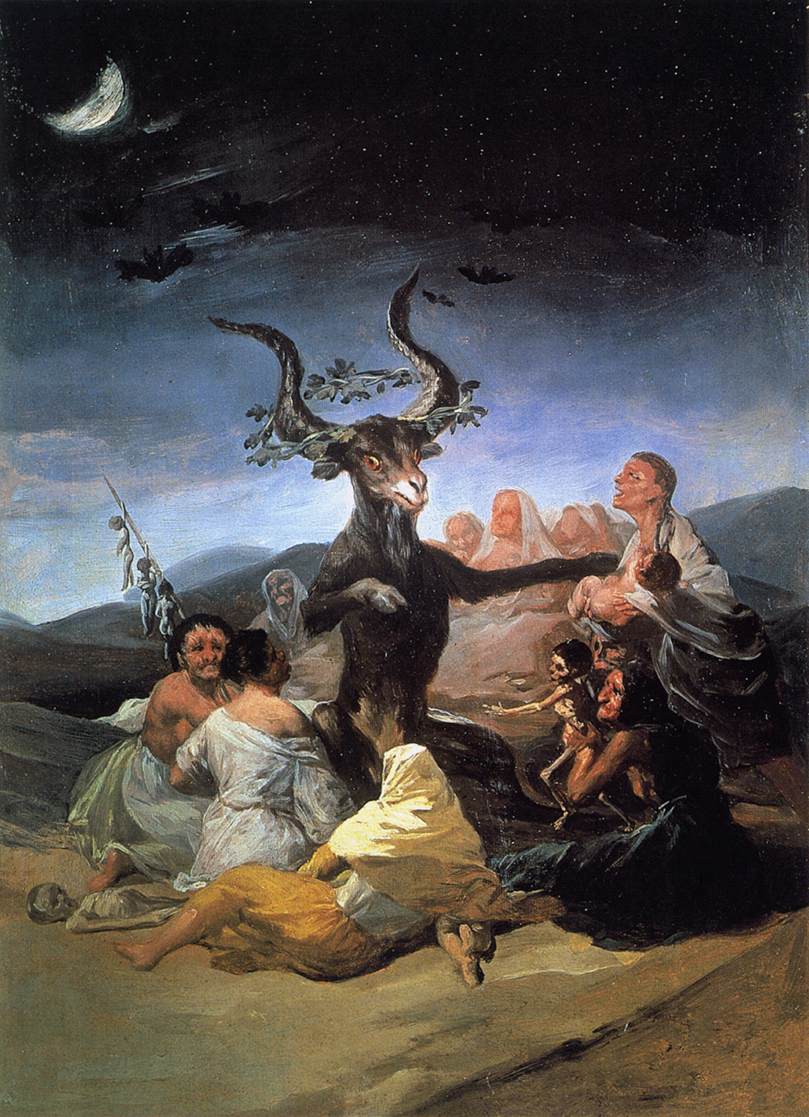
The witch-cult hypothesis is a now discredited idea popularised by the Egyptologist and folklorist Margaret Murray in the 1920s, that the witch trials of the Early Modern period were an attempt to suppress a pagan religion that had survived the Christianisation of Europe. Accused witches were said to have been followers of this old religion, worshipping a horned god, identified as the Devil by Christian prosecutors.[1][2]
Margaret Murray did not invent the idea that witches were practitioners of a surviving pagan religion. As far back as 1749, the Italian cleric Girolamo Tartarotti had suggested in his Del Congresso Notturno delle Lamie (On the Nocturnal Meeting of Witches) that the stereotype of the Early Modern witch was influenced by pre-Christian folk beliefs.[3][4]
The first modern scholar to advance the idea that the witch trials had been orchestrated to eliminate an anti-Christian sect was the German Karl Ernst Jarcke, a professor of criminal law at the University of Berlin. He suggested that witchcraft was a pre-Christian religion that survived Christianisation among the rural population, but that after being condemned as Satanism by the Church, it eventually degenerated into genuine Devil worship and malevolence.[5]
What Margaret Murray added to the mix was that in her The Witch-Cult in Western Europe (1921) she attempted for the first time to offer supporting evidence for the hypothesis.[4]
Academic reception
Margaret’s thesis was initially favourably received, including by a number of eminent scholars none of whom were experts in the witch trials.[6] For the 1961 reprint of The Witch-Cult in Western Europe, the medieval historian Steven Runciman provided a foreword in which he accepted that some of Margaret’s “minor details may be open to criticism”,[7] but was otherwise supportive of her thesis.[8]
Following Margaret’s death in 1963 her work became increasingly criticised. Her conclusions were definitively rejected by the academic community in the 1970s, after two British historians – Keith Thomas and Normam Cohn – exposed the methods Margaret had used to distort the evidence she had put forward to support her thesis.[9] One example is her invention of the idea that a coven must consist of thirteen members, based on a single statement in just one Scottish witch trial, that of Isobel Gowdie Scottish woman accused of witchcraft in 1662 and probably executed, whose detailed testimony provides one of the most comprehensive insights into European witchcraft folklore at the end of the era of witch-hunts., and her “massaging” of figures from a few others to support the idea.[10][11] The historian Ronald Hutton wrote that Margaret had treated her source material with “reckless abandon”.[12]
Influence
There can be little doubt that the impact of Margaret Murray’s ideas rests on the witchcraft article she was commissioned to write for the 1929 edition of the Encyclopedia Britannica. In it, she set out her own interpretation of the subject, and presented it as if it were universally accepted. Her entry was reprinted in subsequent editions until 1969.[10]
During the 1950s several British occultists claimed to have discovered vestiges of the surviving witch cult, but the earliest to do so was Gerald Gardner, who in 1939 wrote that he had discovered a coven of such witches, the New Forest coven Alleged group of witches who convened around the New Forest in Southern England, whose beliefs and practices formed the basis of Gardnerian Wicca..[13] Gardner went on, in his book Witchcraft Today (1954), to give a name to this supposed ancient pagan religion, Wicca.[14]
