
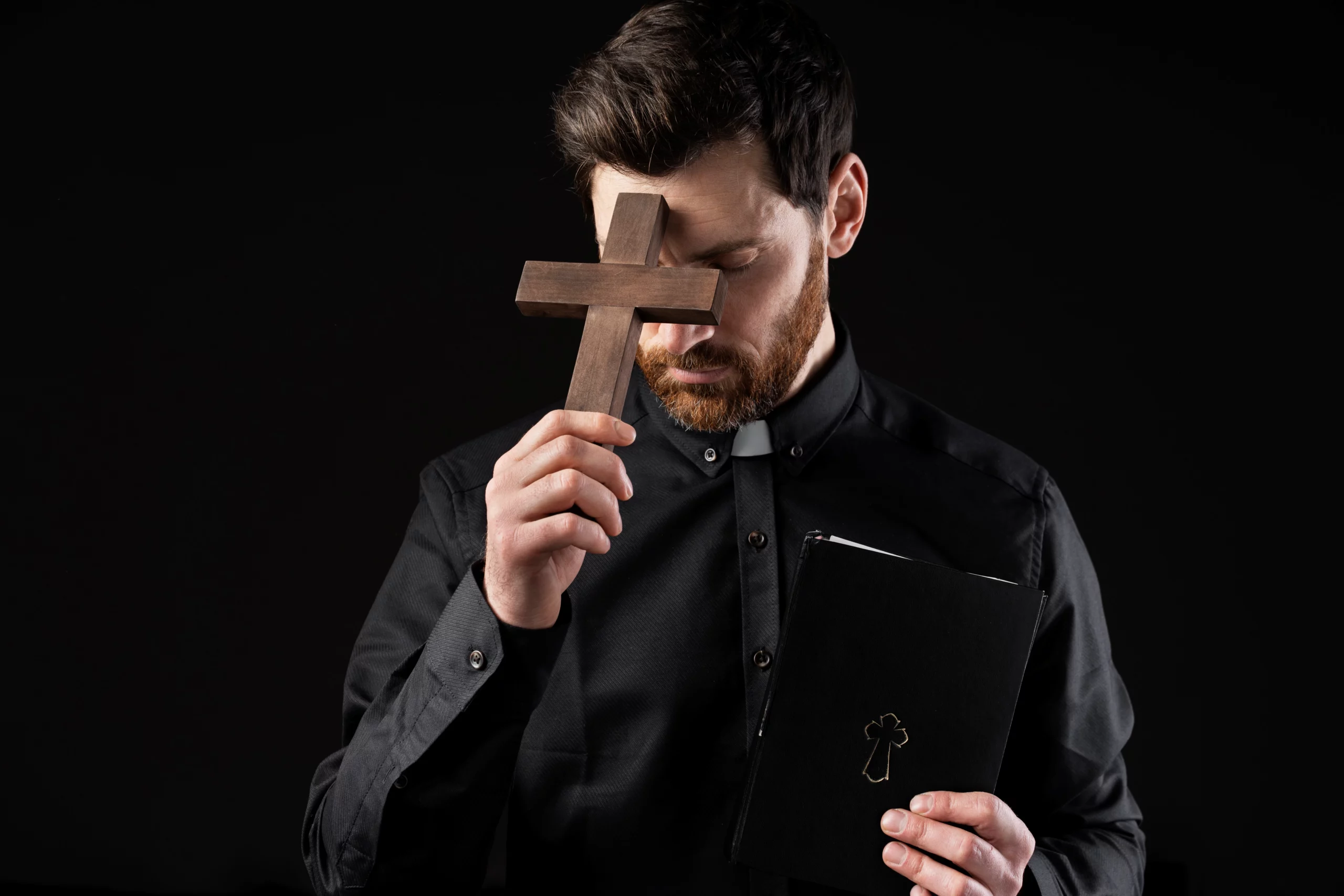
Exorcism is the practice of expelling demons or evil spirits from a person or area that is believed to be possessed.[1] The word is derived from the Late Latin exorcismus,[2] which in turn was derived from the Ancient Greek exorkizó, meaning to swear an oath.[3]
In Ancient Greek culture, swearing an oath involved invoking a deity to punish the oath-taker if the oath was not kept. That invocation of a deity by “powerful oaths” to perform a specific task lies at the heart of the idea of exorcism.[3]
The historian Francis Young has suggested that exorcisms are probably more widespread in contemporary England than at any other time in the country’s history.[3] A 2017 report by the Christian thinktank Theos warned of an “astonishing increase” in the “booming industry” of exorcisms, not all of which were performed by Church of England ministers.[4]
Early history
The Church of England in its present form, as the established church with the monarch as its Supreme Governor, was established by the Act of Supremacy 1559 (1 Eliz. 1. c. 1).[5] Medieval England had no tradition of clerical exorcisms, despite the belief in demonic possession being as strong among the general population as in other Christian countries,[6][a]Those who believed themselves to be possessed would make pilgrimages to the shrines of saints, such as St Bartholomew’s Hospital in Smithfield, London.[6] although there was a longstanding tradition of clerical ghost-laying.[7]
Exorcism was introduced into the Church of England in the 1560s;[8] the earliest recorded exorcism was carried out in Chester in February 1564, that of Ann Mylner. She was walking home when she was “sodaynlye taken wyth great feare, and thoughte that she saw a whyte thing compassing her round about”. She subsequently found herself sore all over, and began to go into fits and trances. John Lane, the rector of Alford and later a canon of Chester Cathedral, successfully performed the exorcism, which involved blowing vinegar into Ann’s nostrils.[9]
Canon 72, passed at the Convocation of Canterbury on 29 February 1604, forbade excorcism without an episcopal licence, and there is no evidence that any such licence was ever granted by an English bishop.[10]
Gilbert Shaw
The arrival of Spiritualism System of beliefs and practices intended to establish communication with the spirits of the dead. in England in 1852 marked a “watershed” in the Church of England’s attitude to demonology, although it was not until the 1920s that an Anglican priest in England, Gilbert Shaw, began to conduct exorcisms of places. Exorcisms of persons remained unknown until 1943, when Shaw conducted the first such exorcism by an Anglican priest in England in modern times.[11]
Shaw soon established a reputation as an authority on exorcism, and during the 1950s acted as an advisor to the Archbishop of Canterbury on paranormal matters. Shaw was largely responsible for the section on exorcism in a report on healing produced by the church in 1958.[11]
York Report
Until 1969 exorcisms were permitted under canon law, provided that permission had been obtained from the diocesan bishop. The release of the film The Exorcist in 1973 resulted in an “epidemic” of reported possessions, and provoked a resurgence of interest in the topic within the Church of England. As the Bishop of Exeter, Robert Mortimer set up an exorcism commission, which published its report in 1973.[12][13]
The York Report envisaged a future in which frequent exorcisms would become the norm, and proposed that they should be delegated to licensed lay ministers rather than the clergy. There is no evidence that any lay ministers were so licensed.[12]
Present day
In 1974 the Church of England set up the Deliverance Ministry, which resulted in every diocese in the country being equipped with a team trained in exorcism and psychiatry. According to the ministry’s representatives, most cases brought before it have conventional explanations, and actual exorcisms are quite rare; blessings though are sometimes given to those with psychological conditions.[14]
The Church of England’s “definitive publication on exorcism”, Deliverance: Psychic Disturbances and Occult Involvement (2012), was compiled by Michael Perry, a former Archdeacon of Durham Cathedral.[15]
Notes
| a | Those who believed themselves to be possessed would make pilgrimages to the shrines of saints, such as St Bartholomew’s Hospital in Smithfield, London.[6] |
|---|
