


Bootham Lodge, 56 Bootham, as at 2021
Wikimedia Commons
Bootham Lodge is a Grade II listed Structure of particular architectural and/or historic interest deserving of special protection. mansion-style house on Bootham, the main road out of York to the northwest. It was built between 1840 and 1845 for Thomas Walker, a local solicitor. Its original kitchen was in the basement, but a new one was added at the rear soon after the house’s completion.[1][2]
The building was converted into offices in the 20th century. Following its purchase by York City Council, the house served as the district’s births, deaths and marriages registration office until 2003, when it was bought by York Conservation Trust. After its refurbishment, and the addition of a new extension for a civil marriage room,[3] the ground floor was leased back to York Registry Office. The upper floors are leased out separately as offices.[4]
Architecture
Exterior
The three-storey, three-bay, house is built of brick in Flemish bond, with hipped slate roofs. There are two-storey wings to the left and right; the one to the left has a carriage entrance on the ground floor with an elliptical brick arch, and a smaller pedestrian entrance to the right. The ground-floor windows, and the central window on the first floor, have surrounds with Tuscan pilasters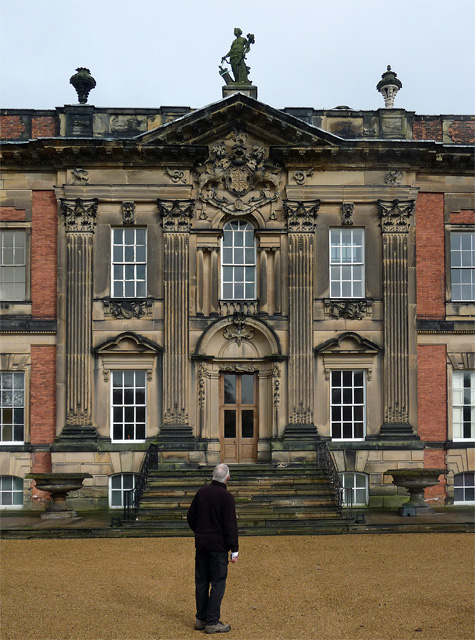 Decorative architectural element used to give the appearance of a supporting column, to articulate an extent of wall. and cornices
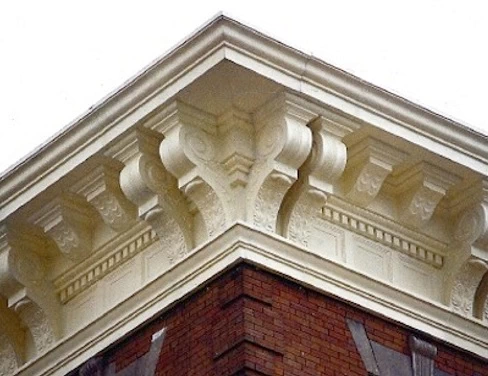 Horizontal moulding crowning a building or part of a building, such as over a door or window, or at the junction of an interior wall and ceiling..[1]
The main entrance to the house is under a porch, in Roman Tuscan style, which supports a balcony with an iron balustrade manufactured by the local John Walker foundry.[4] The window cornices of the outer bays of the main house project as matching balconies to the first-floor windows.[1]
Interior
The entrance passage opens onto a hall featuring a “monumental” Georgian-style ebonised fireplace, with a frieze Horizontal central band of an entablature, known as a pulvinated frieze if it has a convex profile. dominated by the face of Bacchus. Leading off the hall, the main staircase is decorated with elaborate wrought-iron balusters, again supplied by the John Walker foundry. The principal room to the rear has a richly decorated ceiling cornice, and the overdoors feature composite urns and festoons supplied by the carver Francis Wolstenholme of York.[4]
