
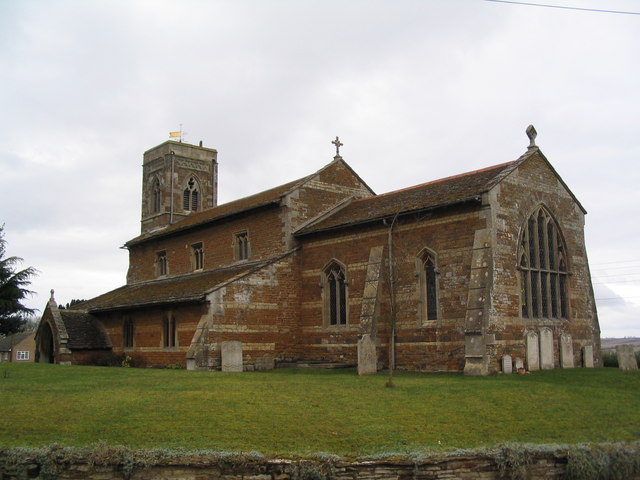

View from the southeast
Wikimedia Commons
St Mary Magdalene and St Andrew’s is an active Anglican church in the village Small rural collection of buildings with a church. of Ridlington, Rutland, one of the ten parishes in the BeneficeOriginally used in feudal societies to describe a grant of land as a reward for services rendered. In modern usage it refers to a collection of parishes working together under a single incumbent. of Rutland Water. It is in the Deanery of Rutland, part of the Diocese of Peterborough.[1] It was designated a Grade II* listed building in 1955.[2]
Most of the building dates from the 13th century; the tower in its present form was added about a century later. But extensive restoration work in the 1860s by Henry Parsons of London left little of the original structure.[1] A Norman tympanum Area above the lintel of a dorway or the base of a pediment, often richly decorated. on the west wall of the south aisle is a fragment of the original building.[2]
Architecture

The church consists of a west tower, nave Central part of a church, used by the laiety., north and south aisles
 Part of a church on either side of the nave or choir, separated from them by arcades, colonnades or piers. More generally, a passageway between seats in an auditorium, shelves in a supermarket and so on., and chancel
 Part of a church containing the altar, used by the officiating clergy..[1] It is built of rubble, ashlar
 Masonry of squared and finely cut or worked stone, commonly used for the facing of a building., and has a tiled roof.[2] A new porch was built in 1887, and in 1903 the upper part of the tower was rebuilt.[1]
The interior contains a wall monument to James Harington and his wife, dated 1613, kneeling in prayer facing each other. There is also a wall-mounted collection of 19th-century and earlier musical instruments, consisting of a bassoon, fiddle, two oboes and a flute.[1][2]
Bells
The tower contains a ring of four bells, all cast by John Taylor & Co. Three were installed in 1903, and the fourth in 1911.[3]
