


All Saints’ from the south
Wikimedia Commons
All Saints’ Church, in Childwall, Liverpool, is an active Anglican parish church in the diocese of Liverpool, the archdeaconry of Liverpool and the deanery of Liverpool South Childwall.[1]
The only surviving medieval church in the Metropolitan Borough of Liverpool, the church was designated a Grade I listed building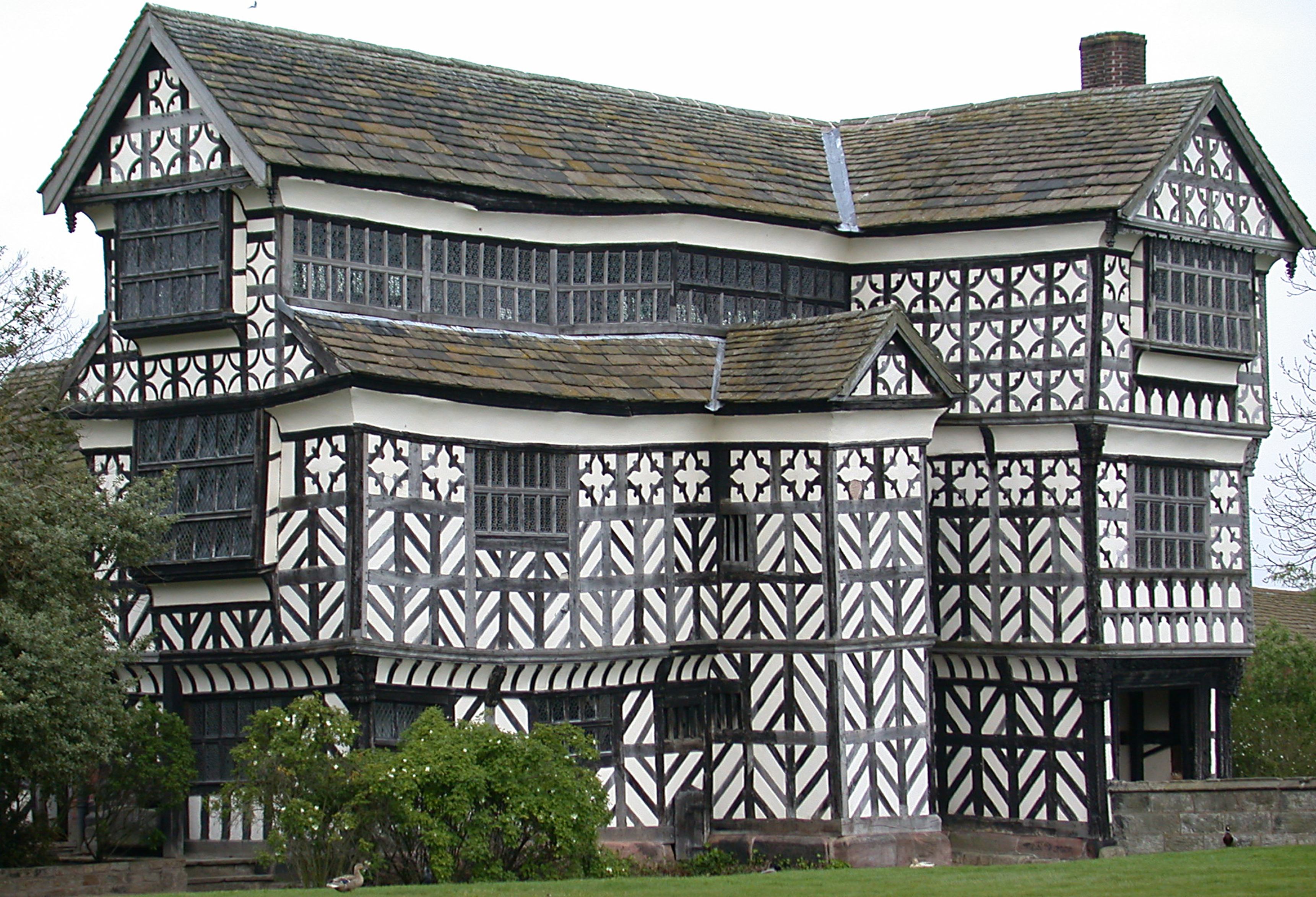 Structure of particular architectural and/or historic interest deserving of special protection. in 1952. A hearse house
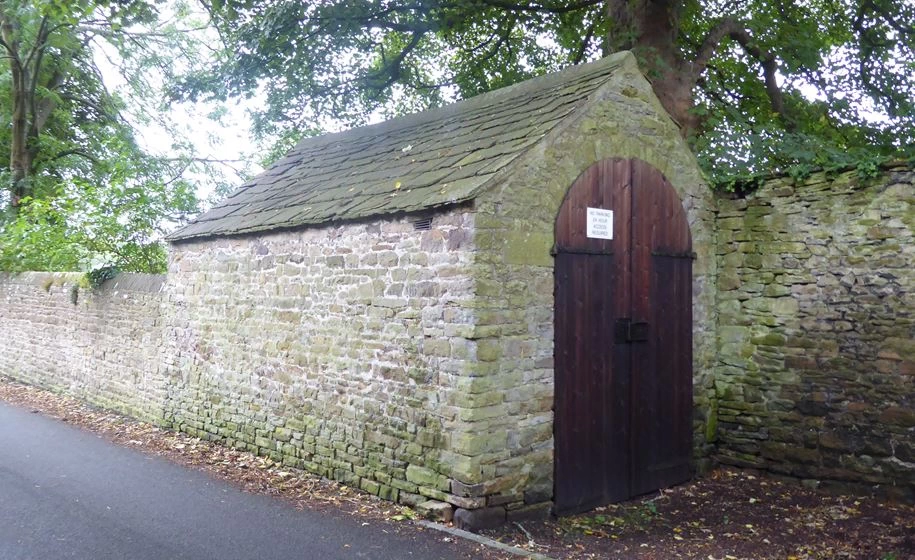 Building used to house the horse-drawn carriages that carried the deceased to their funerals. in the graveyard is separately listed at Grade II.[2][3]
The chancel Part of a church containing the altar, used by the officiating clergy.Part of a church containing the altar, used by the officiating clergy. dates from the 14th century, and the south aisle
 Part of a church on either side of the nave or choir, separated from them by arcades, colonnades or piers. More generally, a passageway between seats in an auditorium, shelves in a supermarket and so on. and porch are probably from the 15th century. Additions were made in the 18th century. The tower and spire were demolished and rebuilt in 1810–1811, a few feet further to the west.[2][4]
The north aisle dates from 1833, and was partly rebuilt between 1900 and 1905.[2] There are two chapels Christian place of prayer and worship, smaller than a church.: the Plumbs’ Chapel on the north side is dated 1716, and on the south side the Salisbury pew (formerly Isaac Green’s Chapel) dates from 1739 to 1740. The church was restored by W. Raffles Brown in 1851–1853. In 1905–1906 the north aisle was rebuilt by James F. Doyle, who also added a vestry
 Room in Christian churches for the storage of liturgical vestments, sacred vessels and parish records..[5]
Architecture
External
The church is built in red sandstone. Its plan consists of a west tower, a nave Central part of a church, used by the laiety. with a clerestoryUppermost range of windows in the wall of a church, or a row of windows above eye-level., a chancelPart of a church containing the altar, used by the officiating clergy.Part of a church containing the altar, used by the officiating clergy., a south aisle and a much wider north aisle which extends to the north of the chancel, and a south porch. A chapelChristian place of prayer and worship, smaller than a church. projects from the north aisle and another from the south aisle. The west wall contains a leper’s squint
 Obliquely cut opening in the chancel wall of a Christian church, allowing celebrants in the side chapels to suspend their own services when the parish priest at the high altar reached the point of consecrating the eucharist., which it has been suggested allowed lepers to view the service without mixing with the congregation in the nave.[6] The tower has a large two-light window, a clock on three faces and two-light bell-openings. The spire is recessed behind an openwork parapet with gargoyles.[2][5]
Internal
All Saints’ has three arcades, with octagonal columns and double-chamfered arches. A gallery extends across the west end of the nave and the south aisle. The chancel roof is wagon-vaulted.[2] A fragment of a Saxon cross-shaft is attached to the west wall of the porch, and a Norman capital, positioned on its side, is set into the east wall of the chancel.[5] The church’s floor originally followed the slope of the hill on which it was built, with the result that the chancel was a metre or so lower than the base of the tower. The chancel was raised in 1851, but the floor of the nave still slopes visibly downward to the east.[5][7]
Box pews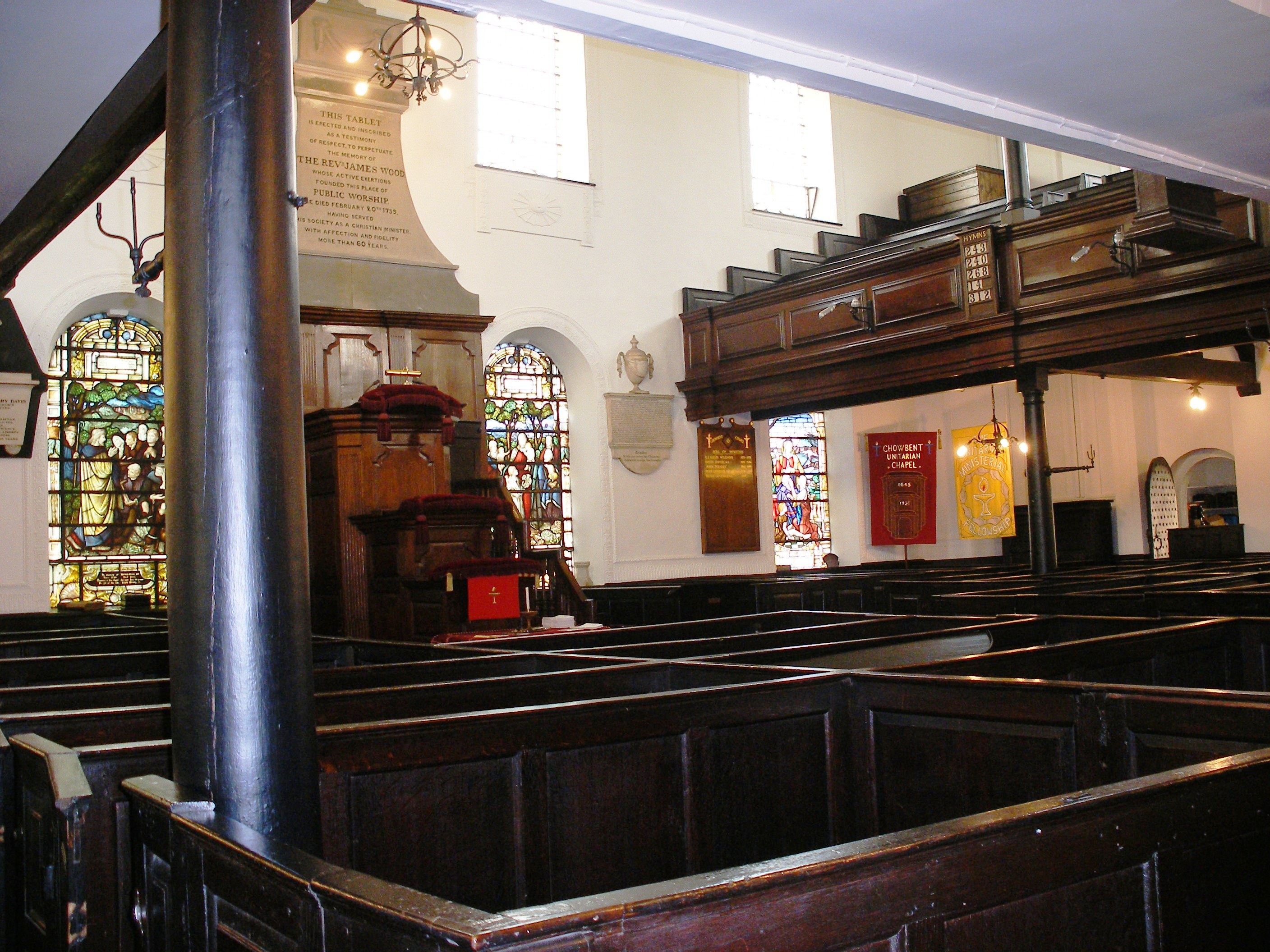 Type of church seating with enclosed sides. were installed in the restoration of 1851–1853.[5] Two funerary recesses in the south aisle contain memorials to the Norris family of Speke Hall.[5]
The church has stained glass windows by William Warrington, Kempe, Heaton, Butler and Bayne, Percy Bacon and Mary Lowndes.[5] In the south wall of the chancel are the remains of a 14th-century piscina,[2] now at floor level owing to the 19th-century raising of the chancel.[7] A 14th-century priests’ door is preserved in a display case on the north wall. There is a ring of six bells, cast in 1912 by John Warner & Sons.[8]
