
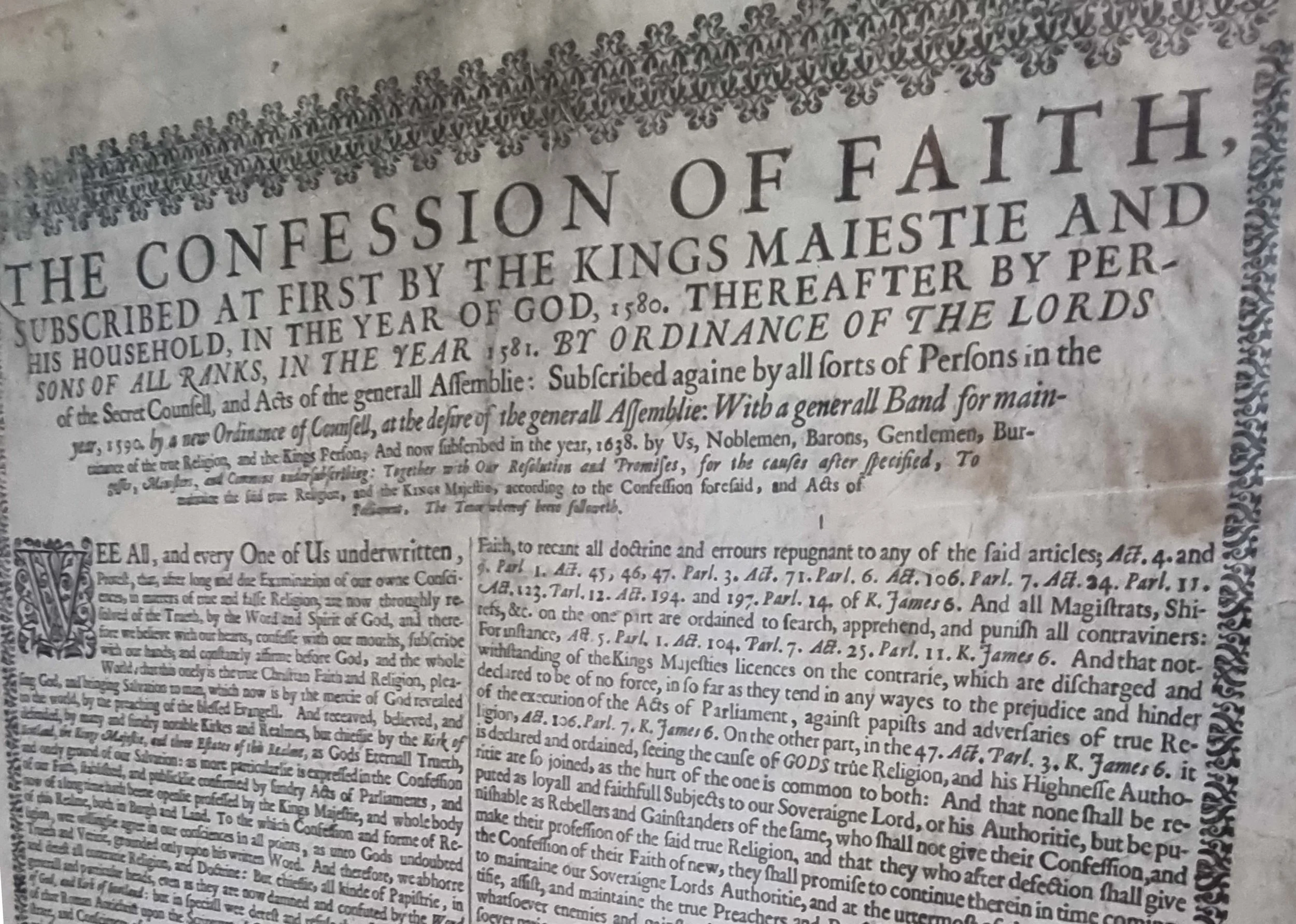
The National Covenant of 1638 was a document produced by Scottish Presbyterians in response to the efforts of King Charles I and William Laud, Archbishop of Canterbury, to force the Scottish church to adopt English liturgical practice and church governance; a particular bone of contention was the introduction of the new Prayer Book the previous year.[1]
The Covenant was drawn up by the Edinburgh lawyer Archibald Johnson and Alexander Henderson, the Presbyterian minister of Leuchars, in Fife. It was first signed on 28 February 1638 in Edinburgh’s Greyfriars Church, and attracted widespread support from all levels of Scottish society. Supporters of the Covenant, known as Covenanters,[1] believed that they were preserving a divinely ordained form of religion, which Charles was seeking to alter.[2]
Background
When James VI of Scotland also became the King of England in 1603, he envisaged a unified Church of England and Scotland as the first step in creating a centralised, unionist state.[3] But although both churches shared much of the same Protestant doctrine, Scottish Presbyterians generally regarded many of the Church of England’s practices as little better than Catholicism.[4]
Content
The National Covenant starts by repeating the Negative or King’s Confession, signed in 1581 as an anti-Catholic statement by James VI.[1][5] This is followed by a list of parliamentary statutes defining the polity and liturgy of the church in Scotland.[1] It concludes with a bond committing the signatories to stand together to maintain the nation’s religion and oppose any changes to it. Signatories were also committed to upholding the king’s authority, although it was understood that did not include obedience to an ill-advised king.[5]
The Covenant had the appearance of working within constitutional precedent, contributing to its appeal to all levels of Scottish society by drawing on a sense of patriotic outrage at the rule and policies of Charles as an absentee monarch. It was also sufficiently vague to avoid any populist backlash, for example by implicitly supporting Presbyterianism without explicitly condemning episcopacy, a hierarchical form of church governance.[1] The historian Roger Mason has described the Covenant as “rehetorically unispiring”, and a “masterpiece of studied ambiguity”; while supporting Presbyterianism, it condemns “recent innovations in worship” without ever saying what they are.[1]
