

Wikimedia Commons
William Mumler (1832 – 16 May 1884) was a Boston jeweller and keen photographer, and the first to make a lucrative business out of spirit photography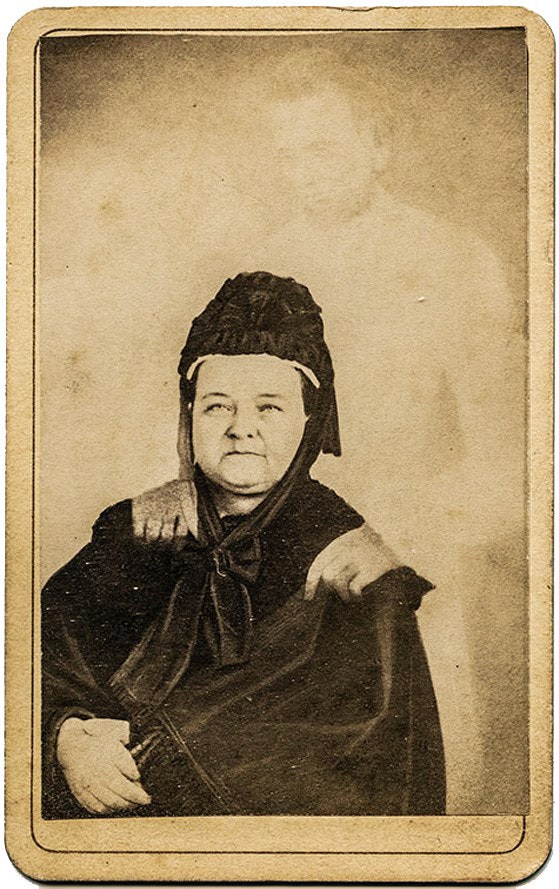 Technique popular in the 19th century to capture the invisible spirits of the deceased..[1][2][3] Despite being recognised as fakes, his photographs were widely circulated during the last quarter of the 19th century, marketed as objects of belief and visual curiosities, within and beyond the spiritualist
 System of beliefs and practices intended to establish communication with the spirits of the dead. movement.[4]
Mumler’s first spirit photograph was apparently accidental, a self-portrait which, when developed, revealed the ghostly figure of a young girl floating by his side. He initially assumed that it had been a double exposure, but after his friends pointed out that the figure bore an uncanny resemblance to his dead cousin, and the story was picked up by the press, Mumler saw a business opportunity.[5]
Mumler set himself up as full-time spirit photographer, continuing to work in Boston before moving to New York City, where his work was analysed by numerous photography experts, none of whom could find any evidence of fraud.[6] Spirit photography was a lucrative business thanks to the enormous death tolls that resulted from the American Civil War (1861–1865), during which an estimated 750,000 soldiers were killed,[7] as bereaved families attempted to communicate with the spirits of their lost relatives.[8]

Wikimedia Commons
Unfortunately for Mumler, some of his customers began to notice that the supposed spirits in their photographs looked remarkably similar to people who had attended his earlier sittings. Mumler was even accused of breaking into houses to steal photographs of the deceased, to incorporate into his spirit photographs.[5] Critics of Mumler’s work included the showman P. T. Barnum, who claimed that Mumler was taking advantage of people whose judgment was clouded by grief. Barnum was just one of many in a chorus of voices accusing Mumler of staging ghosts of people who were in reality still alive.[6]
As the evidence began to accumulate, Mumler was charged with fraud and prosecuted in 1869. Although acquitted, he never recovered financially from the cost of defending the case, and the damage to his reputation, dying in poverty in 1884.[5]

![[modula id="28342"]](https://engole.info/wp-content/uploads/2026/01/Mumler_French.webp)


