
Wikimedia Commons
The Scots Magazine, claimed to be the oldest magazine in the world still in publication – despite several breaks in the history of the title – was first published in 1739 as a current affairs journal. In that role it has covered the end of the Jacobite rebellion, the Napoleonic wars, two world wars and the establishment of the Scottish Parliament.[1] It was intended as a rival to the London-based The Gentleman’s Magazine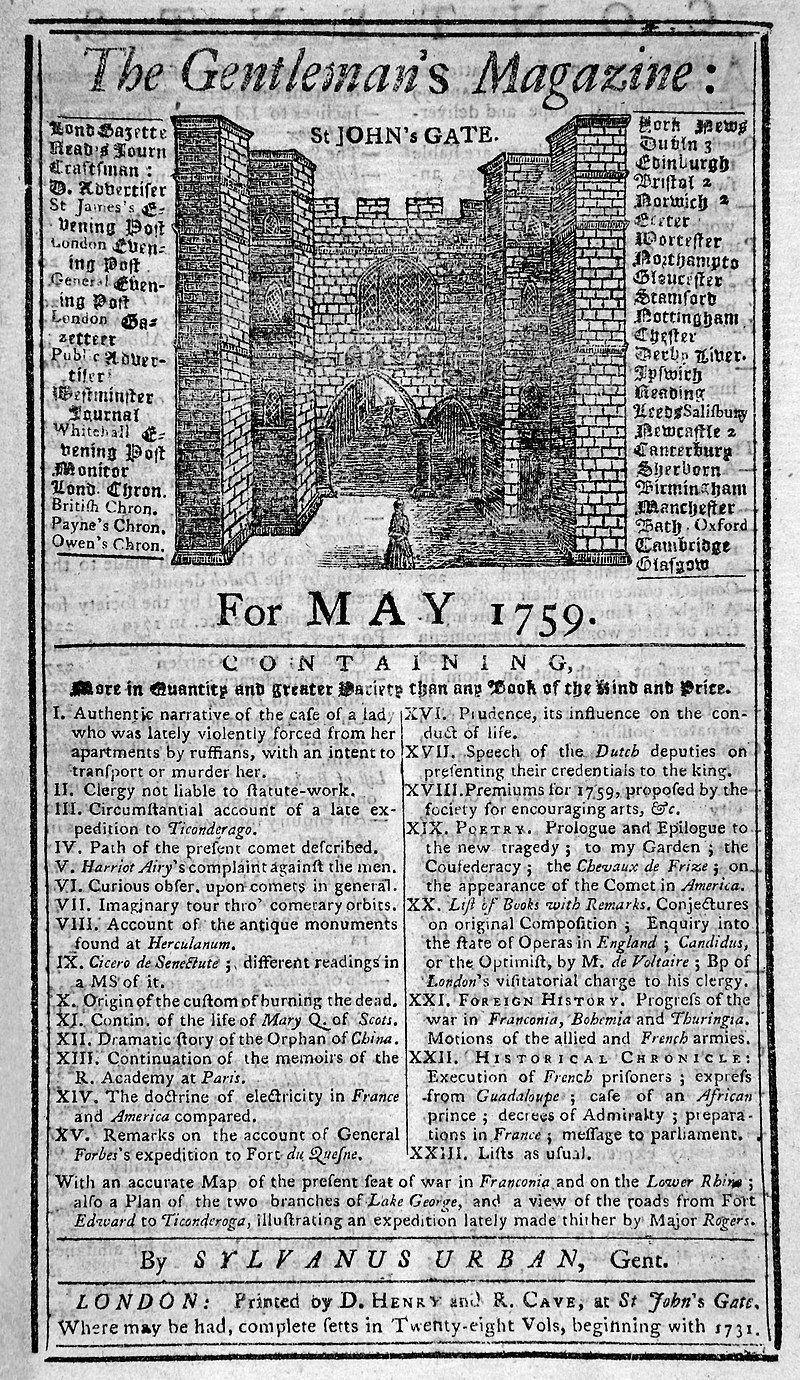 Monthly compendium of the best news, essays and information from the daily and weekly newspapers, published from 1731 until 1914., in order that “our countrymen might have the production of every month sooner, cheaper and better collected than before”.[2][3]
The first issue, dated Monday 9 February 1739, cost sixpence, and appeared in a blue cover with the Latin motto Ne quid falsi dicere audeat, ne quid veri non audeat, meaning “Don’t dare say anything false, don’t dare anything true”. Popular throughout the 18th century, it innovated a register of births, deaths and marriages, which other journals soon copied. From 1759 until 1765 it was edited by William Smellie, who went on to edit the first edition of the Encyclopaedia Britannica.[2][3]
The Scottish publisher and bookseller Archibald Constable bought the magazine in 1801, and three years later amalgamated it with the Edinburgh Magazine and Literary Miscellany. But by 1826 rival magazines such as the Edinburgh Review and Blackwood’s Magazine had so eroded The Scots Magazine‘s readership that it ceased publication. Attempts to revive it as the New Scots Magazine in 1828 and the Scots Weekly Magazine in 1832 were unsuccessful.[2][3]
The Dundee firm of D. C. Thomson & Co acquired the title in 1927, and have continued to publish it since then.[2]

