

46 × 29.5 cm (18 × 12 in)
Wikimedia Commons
Belvedere is a lithograph created by the Dutch artist M. C. Escher in 1958. It shows an at first sight plausible-looking belvedere that would be impossible to build, modelled after the Necker cube shown drawn on the piece of paper lying in the lower left foreground.[1][a]A belvedere is a turret room, at the top of a house or tower, providing distant views across the countryside. The name is derived from the Italian belvedere, meaning “fair sight”.[2][3]
As with the Necker cube, Belvedere illustrates a drawing of an object that displays a different reality when viewed from above or below, and in particular front and back simultaneously, which would be impossible in the three-dimensional world being depicted. Two people are climbing a ladder on the floor of the lower platform, but when they reach the top they find themselves outside the building, and having to re-enter. The man sittting at the foot of the building holds an impossible cube, which he appears to be constructing from the diagram at his feet, apparently oblivious to the fact that the belvedere behind him has been built in the same impossible style.[1] The woman about to climb the steps of the building is copied from Hieronymus Bosch’s The Garden of Earthly Delights.[4]
Belvedere is one of the three of his works that Escher characterised as impossible buildings. The two others are Ascending and Descending and Waterfall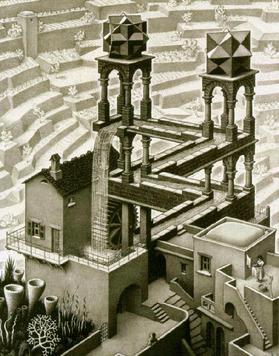 Lithograph by M. C. Escher, depicting an impossible perpetual motion machine..[5]

